
Our Accomplishments
The Chesapeake Bay Program is renowned as a regional, national and international leader in ecosystem science, modeling and restoration partnerships.
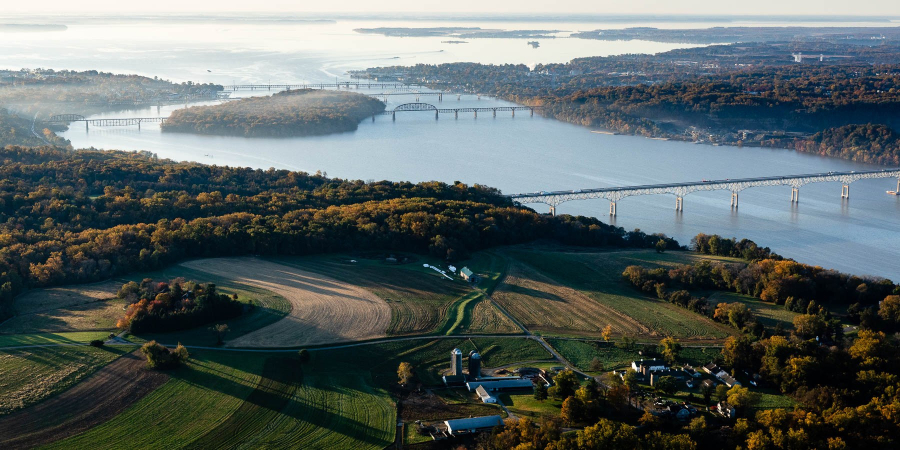
Since its formation in the 1980s, the Chesapeake Bay Program has made significant accomplishments in its efforts to restore and protect the Bay, becoming a regional, national and international leader in ecosystem science, modeling and restoration partnerships.
Partnership model
Through the Bay Program, leaders and experts from a vast range of groups work across political boundaries to restore the Bay, showing that a cooperative approach is an effective way to achieve environmental results. By working together, our partners promote a more complete understanding of Bay issues and can use limited resources more effectively.
The Bay Program's partnership model has been recognized and emulated worldwide:
- It served as the prototype for the U.S. Environmental Protection Agency’s National Estuaries Program.
- It was highlighted as a model program at the White House Conference on Cooperative Conservation in 2005.
- It regularly hosts delegations from other large-scale restoration efforts around the United States and internationally, including visitors from Panama, Japan, China, Macau, a joint Israeli-Palestinian delegation and the European Organisation for Economic Cooperation and Development.
Environmental results
Restoring the Chesapeake Bay and its 64,000-square-mile watershed is an enormous undertaking. Four centuries of population growth took their toll on the Bay ecosystem, resulting in polluted waterways and dwindling natural resources. After more than 35 years of restoration efforts, long-term pollution trends from the Bay’s major rivers generally appear to be decreasing. While that's good news, a clean Bay is the ultimate restoration measure. Some signs are positive, but other key indicators are lagging. Our partners are working harder than ever to bring the estuary back to health.
State-of-the-art scientific research
Our science community has pioneered numerous cutting-edge scientific efforts that have advanced ecosystem restoration in the Bay region and throughout the world:
- The original scientific study that first identified excess nutrients as the main source of pollution in the Bay was conducted by the EPA with strong support from the Bay states. In the early 1990s, the Bay Program worked with EPA and NOAA researchers to establish that airborne nitrogen was a contributor to pollution in the Bay and other estuaries.
- Partners and other stakeholders use a suite of computer models that are among the most sophisticated, studied and respected in the world. The models provide a comprehensive view of the Chesapeake ecosystem from the depths of the Bay to the upper reaches of the watershed, from the land to the air.
Indicators as a management tool
Establishing numeric goals and deadlines for environmental restoration was unprecedented when the Bay Program first included them in the 1987 Chesapeake Bay Agreement. But the practice has now become a Bay Program hallmark and a common way for restoration programs across the country to measure progress.
Landmark cooperative agreements
In 2000, Bay Program partners signed the historic Chesapeake 2000 agreement, which established 102 goals to reduce pollution, restore habitats, protect living resources, promote sound land use practices and engage the public in Bay restoration. At the time, Chesapeake 2000 was considered the most comprehensive large-scale ecosystem restoration blueprint in the nation.
Since Chesapeake 2000, the Bay Program has evolved toward using a mix of short- and long-term goals to improve its accountability and accelerate Bay restoration. In 2014, Bay Program partners signed the Chesapeake Bay Watershed Agreement, a landmark agreement that includes 10 interrelated goals and 31 outcomes that work toward advancing the restoration and protection of the Bay, its tributaries and the lands that surround them. The partnership uses ChesapeakeDecisions as a guide for the Strategy Review System: a structured process that applies adaptive management to our work toward the Chesapeake Bay Watershed Agreement.