
Snowy Egret
Egretta thula
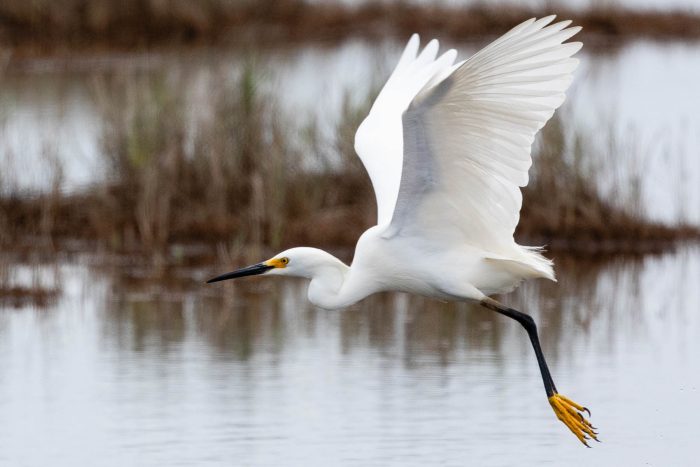
The snowy egret is a medium-sized white heron with a slender black bill and distinctive yellow feet. It visits the Chesapeake Bay’s marshes, wetlands and shallow waters from spring through autumn.
This section shows one large critter image at a time. Use the thumbnails that follow to select a specific image to display here.
This gallery contains a grid of small thumbnails. Selecting a thumbnail will change the main image in the preceding section.
Appearance
The snowy egret has a white body and grows to 27 inches tall with a wingspan of 41 inches. During the breeding season, it has long, feathery plumes on its head, neck and breast. It has a slender black bill, black legs and yellow feet.
Feeding
Snowy egrets eat mostly fish and crustaceans, but will also feed on frogs, snakes, worms and insects. They scurry around the water as they hunt, which is much more active than other herons and egrets, which stand still and silently stalk their prey. They use their feet to stir up mud under water, then stabs their bills into the water to find prey. Snowy egrets often forage in groups with other aquatic birds.
Predators
Owls, hawks, raccoons and poisonous snakes prey upon snowy egrets and their young.
Flight
In flight, the snowy egret holds its head back and its neck in a tight curve. It flies with rapid wingbeats and often flies in flocks when returning to roosting areas in the evening.
Voice
This bird's call is a low croak; during breeding season, it may make a woola-woola-woola sound.
Reproduction and life cycle
Snowy egrets nest and breed in colonies, called rookeries, with other herons, egrets and ibises. Rookeries are found on Bay islands such as Poplar, Tangier and Fisherman. They nest in low shrubs or trees near the water. Males perform courtship rituals such as vocalizations and flight displays to attract a mate. Once they find a mate, the female builds a nest made out of woven sticks and twigs. Females lay three to six pale, greenish-blue eggs, which hatch in approximately 24 days. Chicks usually fledge two weeks after hatching. Snowy egrets can live as long as 17 years.
Did you know?
- Snowy egrets are one of three white herons that visit the Chesapeake Bay region. The other two are the great egret and the cattle egret.
- Long, wispy plumage grows on the snowy egret's back, neck and head during breeding season. In the 1800s, snowy egret populations were decimated due to the popularity of these plumes in fashion. With the help of protections that started in the 20th century, populations have recovered.
Sources and additional information
- Life in the Chesapeake Bay by Alice Jane Lippson and Robert L. Lippson
- Animal Diversity Web: Egretta thula – University of Michigan Museum of Zoology
- All About Birds: Snowy Egret – The Cornell Lab of Ornithology
- NatureWorks: Snowy Egret – New Hampshire Public Television
- Snowy Egret – The Assateague Naturalist