
A little fish with big significance for clean water
Four states share the same state fish—and a commitment to protecting the habitat it needs for survival
Show image description
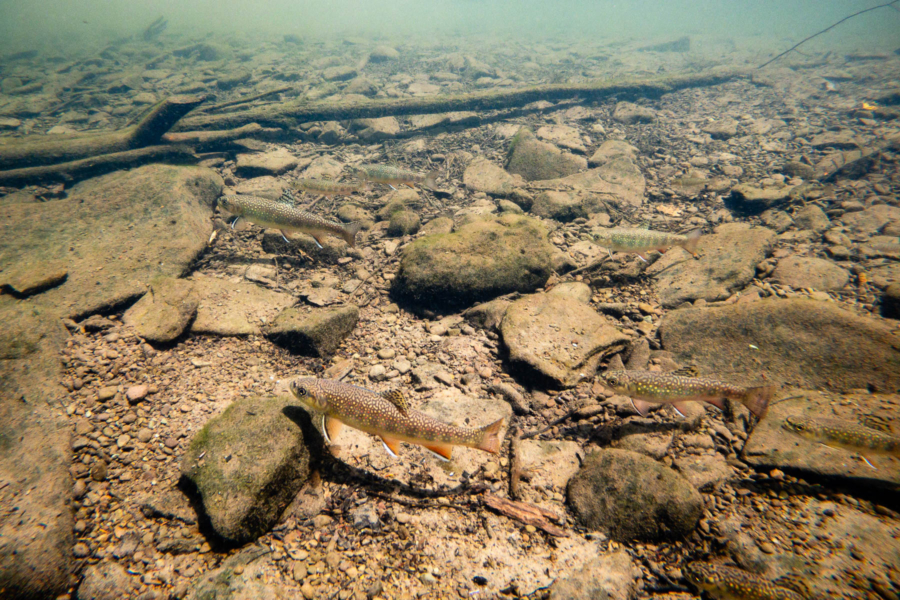
Eight small fish swim in clear water that is filled with rocks, sediment and a large branch in the distance.
Did you know that four states in the Chesapeake Bay watershed recognize the same species as their official state fish?
Pennsylvania was the first to declare the brook trout its state fish in 1970, followed by West Virginia in 1973. New York joined the party in 1975, as did Virginia in 1993 (although both use the official title of state freshwater fish).
For Pennsylvania, Virginia and West Virginia, the “brookie” is the only native trout species found in the state. For all of them—including New York—a large part of the decision to give brook trout this distinction is due to the iconic image of the fish in its natural habitat of clean, cold mountain streams, covered by tree canopy.
The Chesapeake Bay Program included brook trout as an outcome in the 2014 Chesapeake Bay Watershed Agreement for similar reasons. Brook trout depend on cold, clean water to survive, making them a strong indicator of water quality. When stream temperatures rise above 68 degrees Fahrenheit, the fish become stressed and may die—positioning them as a clear barometer for changing environmental conditions.
Brook trout populations began to decline in the late 19th and early 20th centuries, primarily due to the exploding timber harvest and loss of old-growth forests. Nonnative trout species moved in, competing for habitat and resources. Current threats come from abandoned mine drainage, polluted runoff, rising water and air temperatures, and changes in land use.
A 2015 assessment completed by the Eastern Brook Trout Joint Venture found that wild brook trout occupied 12,819 square miles of habitat across the Chesapeake Bay watershed, along with brown and rainbow trout. Of that, 7,491 square miles are considered to be allopatric–or only occupied by brook trout. Using this as a baseline, the 2014 Watershed Agreement outcome called for approximately 53 square miles of habitat to be restored each year, which would make for an overall increase of 8% of habitat occupied by wild brook trout by 2025.
A report released in 2024, Facilitating Brook Trout Outcome Attainability through Coordination with CBP Jurisdictions and Partners, found that occupied brook trout habitat increased by 0.5% between 2016–2024. This figure was determined by tracking habitat improvement projects, and their documented gains and losses in brook trout occupancy, between 2016–2022.
Given the importance of brook trout to the Chesapeake region, it should come as no surprise that an updated outcome was included in the revised Chesapeake Bay Watershed Agreement. In particular, it seeks to increase occupancy, abundance and resiliency to changing environmental conditions by protecting and enhancing brook trout within the watershed. It calls for reducing identified brook trout threats by 15%, increasing abundance at 10 long-term monitoring sites and raising occupancy by 1.5%, or 233 miles—all by 2040.
Over the next 18 months, Chesapeake Bay Program partners will be developing Management Strategies for the refreshed Brook Trout Outcome. Interested in staying up-to-date with what’s happening with brook trout? Send a note to comments@chesapeakebay.net and we’ll make sure to keep you updated!
Comments
There are no comments.
Thank you!
Your comment has been received. Before it can be published, the comment will be reviewed by our team to ensure it adheres with our rules of engagement.
Back to recent stories