
American Oystercatcher
(Haematopus palliatus)
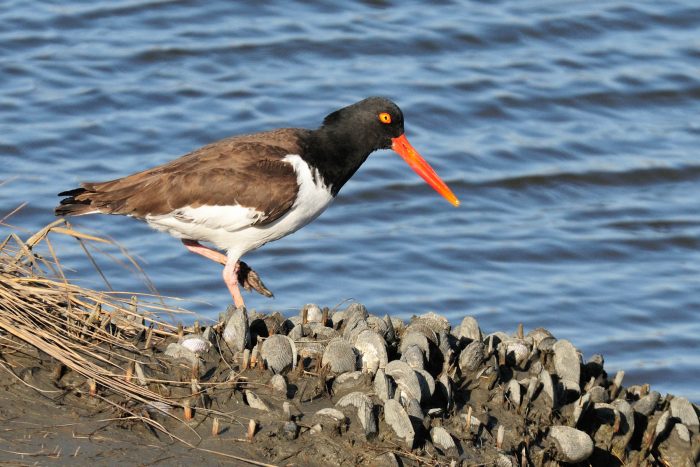
The American oystercatcher is a large, stocky shorebird with a distinctive long, blade-like, reddish-orange bill. It lives on beaches, mud flats and exposed oyster bars along the lower Chesapeake Bay.
This section shows one large critter image at a time. Use the thumbnails that follow to select a specific image to display here.
This gallery contains a grid of small thumbnails. Selecting a thumbnail will change the main image in the preceding section.
Appearance
The American oystercatcher grows up to 19 inches in length and has a large, stocky body. It has a black head, brownish back, white belly and large white patches on its wings, tail and rump. Its eyes are yellow with an orange ring around them. It has a long, straight, reddish-orange bill and pale pink legs.
Feeding
The American oystercatcher eats oysters and other mollusks, as well as fiddler crabs. It probes through sand and mud to find its prey, thrusting its powerful, blade-like bill between a mollusk’s open shells and stabbing the mollusk’s adductor muscle, then feeding on the meat. It will also use its bill to hammer a mollusk’s shell until it cracks.
Predators
Oystercatchers are vulnerable to attacks from gulls and sensitive to beach disturbances by humans.
Flight
These birds can be identified in flight by their broad, white wing stripes and long, bright orange bills.
Voice
Oystercatchers are very noisy birds; they make a shrill wheep or kleep, as well as loud pic pic pics.
Reproduction and life cycle
In spring, oystercatchers will nest on sandy areas along the Bay’s shoreline, particularly around Tangier Sound. To make their nest, adults make a shallow depression in the sand and line it with crushed shells and other beach debris. Oystercatchers will build as many as five nests to confuse predators. The female lays 2-4 sandy-colored eggs into the nest. Both parents take care of the nest and eggs. Juveniles have a mottled appearance that differs slightly from adults’ plumage.
Did you know?
- The oystercatcher was historically known as the sea pie, but was re-named in 1731 when naturalist Mark Catesby observed the bird eating oysters.
- Although oystercatchers were nearly hunted to extinction in the 19th century for their plumage, populations recovered well in the 20th century.
- Oystercatchers have been known to drown while trying to feed: tightly rooted mussels sometimes clamps down on an oystercatcher's bill, holding the bird in place until the tide comes in.
Sources and additional information
- Life in the Chesapeake Bay by Alice Jane Lippson and Robert L. Lippson
- Chesapeake Bay: Nature of the Estuary, A Field Guide by Christopher P. White
- All About Birds: American Oystercatcher – The Cornell Lab of Ornithology
- NatureWorks: American Oystercatcher – New Hampshire Public Television