
Phragmites
(Phragmites australis)
Phragmites is an invasive perennial plant. It grows in wetlands and along roadsides and shorelines throughout the Chesapeake Bay watershed.
This section shows one large critter image at a time. Use the thumbnails that follow to select a specific image to display here.
This gallery contains a grid of small thumbnails. Selecting a thumbnail will change the main image in the preceding section.
Appearance
Phragmites have feathery seed plumes at the top of tall, stiff stems. Young plants have purplish-brown seed plumes that turn tan or whitish as the plant matures. Phragmites' sheath-like leaves grow two feet long and taper to a point at the tip.
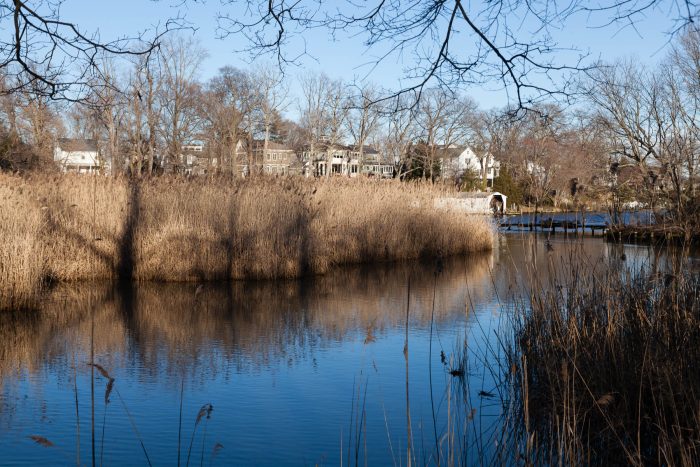
Their foliage is gray-green during the growing season. In autumn, foliage turns brown and most leaves drop off, leaving only the feathery plumes. Phragmites can grow to 15 feet tall.
Reproduction and life cycle
Feathery plumes begin to appear in June, and by August, they are filled with seeds. Plants cross-pollinate in late August and early September. In autumn, phragmites sheds its seeds, which are spread by wind and water.
By the first frost, the plant’s food reserves move from its leaves to its rhizomes which is the underground portion of the plant’s stem. The leaves die and fall off, leaving only dead brown stems and plumes.
Pragmites also spread rapidly by rhizomes. They form a dense underground network that can be several feet deep and spread several feet horizontally in a single season. New seedlings begin to grow in early spring of the next year.
Did you know?
- Phragmites comes from the Greek word Phragma meaning “fence." They are also known as common reed or reed grass.
- Phragmites form large, dense stands that crowd out other plants.
- They were introduced to the United States in the 19th century when ships from Eurasia inadvertently carried phragmites seeds in their ballast. Although there is a type of phragmites that is native to the U.S., it is very rare.
- Unlike many native wetland plants, phragmites is not a valuable food source for waterfowl.
Sources and additional information
- Life in the Chesapeake Bay by Alice Jane Lippson and Robert L. Lippson
- PLANTS Profile for Phragmites australis – USDA Natural Resources Conservation Service
- Phragmites australis – U.S. Forest Service
- Phragmites – Pennsylvania Sea Grant
- Plant Conservation Alliance Alien Plant Working Group: Common Reed – National Park Service