
Sea slugs
(Class: Gastropoda)
Sea slugs are soft-bodied, shell-less mollusks that live throughout the Chesapeake Bay.
This section shows one large critter image at a time. Use the thumbnails that follow to select a specific image to display here.
This gallery contains a grid of small thumbnails. Selecting a thumbnail will change the main image in the preceding section.
Appearance
Eight species of sea slugs can be found in the Chesapeake Bay:
- The cross-bearer sea slug, Hermaea cruciata
- The dusky sea slug, Stiliger fuscatus
- The eastern emerald elysia, Elysia chlorotica
- The kitty-cat sea slug, Elysia catula
- The limpet nudibranch, Doridella obscura
- The ridged-back nudibranch, Polycerella conyma
- The rough-back nudibranch, Doris verrucosa
- The striped nudibranch, Cratena pilata
The first four species are sacoglossans, which are sea slugs that feed on plants. The last four are nudibranchs, which are carnivorous sea slugs.
Sea slugs have soft bodies that look similar to garden slugs. They vary in size from one-eighth of an inch to 1.5 inches in length. Color varies; sacoglossans are often uniformly green, while nudibranchs blend in with the surface they are on. Sea slugs have tentacles on their head, as well as sensory tentacles called rhinopohores toward the back of their body. Various gills, tubercles and club-shaped growths appear on the top part of their bodies.
Feeding
Sea slugs are categorized depending on their diet. Sacoglossans are herbivores that suck out and feed on the internal contents of algae. Nudibranchs are carnivores and feed on tiny animals. Each nudibranch family tends to eat one or two particular types of food.
Predators
Because they lack shells, nudibranchs rely on bright coloration and strong scent to avoid predators. Some nudibranch species can eat the stinging cells of jellyfish and store them in their cerata; these “adopted” cells become part of the sea slug’s defense system.
Reproduction and life cycle
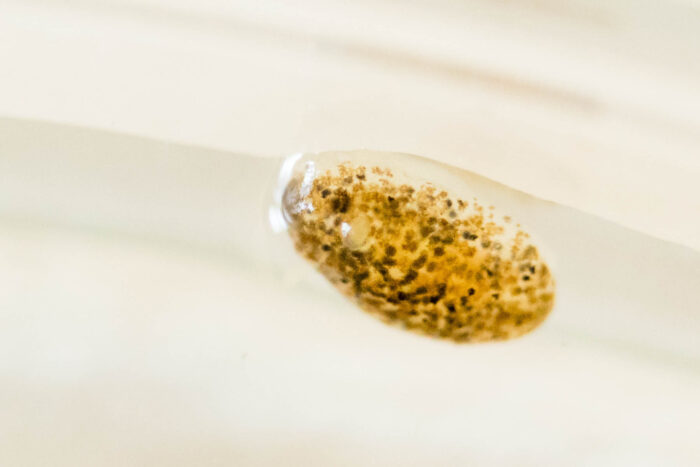
Sea slugs have both male and female sex organs. They are able to mate with any individual of the same species. Eggs may take 5 to 50 days to develop into free-swimming larvae.
Did you know?
- If taken out of water, sea slugs turn into shapeless lumps. To see their true shape, keep them in water.
- Sea slugs are mollusks. They shed their shells before they hatch or when they are larvae.
Sources and additional information
- Life in the Chesapeake Bay by Alice Jane Lippson and Robert L. Lippson
- The Sea Slug Forum - Australian Museum