
Southern flying squirrel
(Glaucomys volans)
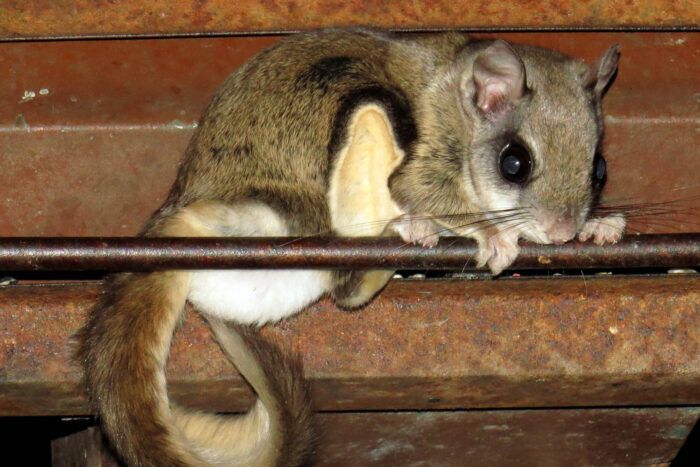
The southern flying squirrel is a small, grayish-brown mammal. It can be found throughout the Chesapeake Bay watershed in hardwood forests and areas with lots of deciduous trees.
This section shows one large critter image at a time. Use the thumbnails that follow to select a specific image to display here.
This gallery contains a grid of small thumbnails. Selecting a thumbnail will change the main image in the preceding section.
Appearance
The southern flying squirrel has soft, grayish-brown fur and a white belly. Its large eyes have dark rings around them, and it has prominent ears and whiskers. A fold of loose skin called a patagium stretches from its ankle to its wrist. Its broad, flattened tail is covered in fur. Southern flying squirrels grow to about nine to 10 inches in length and weigh about two to four ounces.
Feeding
These squirrels mainly feed on nuts and acorns, especially those from hickory trees. They also eat berries, seeds, flowers, mushrooms, insects, bird eggs and dead mice. Each autumn, they may store up to 15,000 nuts to eat during winter, which they store underground or in tree cavities and crevices.
Predators
Hawks, owls, domestic cats, snakes, raccoons, weasels and red foxes may prey upon flying squirrels, who avoid predators by staying alert, being nocturnal and quickly running or gliding away from danger.
Flight
The southern flying squirrel does not actually “fly,” but glides by extending its legs to stretch out its fold of skin like a parachute. It usually glides about 20 to 30 feet, but has been recorded gliding up to 240 feet. Very agile, it steers around branches and other obstacles by using its tail as a rudder.
Voice
These squirrels produce vocalizations, including a high-pitched tseet and other chirping sounds. Vocalizations are sometimes above the frequency range of the human ear. Some scientists think that flying squirrels may use their vocalizations for echolocation.
Reproduction and life cycle
Adults mate twice per year: once in February to March and again in late May to July. Females can produce two litters of two to four young each year if conditions are good. Gestation lasts 40 days. Males do not care for their young and typically leave before the litter is born. Young are born naked and helpless.
Their ears open after two to six days, they begin to develop fur within a week and their eyes open after about four weeks. Young are weaned at six to eight weeks and able to glide soon after that. Young typically remain with their mother for about four months or until the next litter is born and reach sexual maturity in one year. Southern flying squirrels can reach five to six years old in the wild, but most probably die within their first year.
Did you know?
- In some areas, southern flying squirrels may outnumber the common gray squirrel.
- Nests are typically made in natural cavities or old woodpecker holes about 15 to 20 feet high in a tree and the squirrel will occasionally build a summer leaf nest
- This specues does not hibernate, but forms a common nest with a group of 10 to 20 flying squirrels to keep warm.
- Because they are nocturnal, they are rarely seen by people.
- Southern flying squirrels have excellent senses of smell, vision, hearing and touch, and their large eyes allow them to see at night.
Sources and additional information
- Wildlife Information: Southern Flying Squirrel – Virginia Department of Wildlife Resources
- Animal Diversity Web: Glaucomys volans – University of Michigan Museum of Zoology
- Flying Squirrel Species Guide – Nebraska Game and Parks Commission