
White-tailed deer
(Odocoileus virginianus)
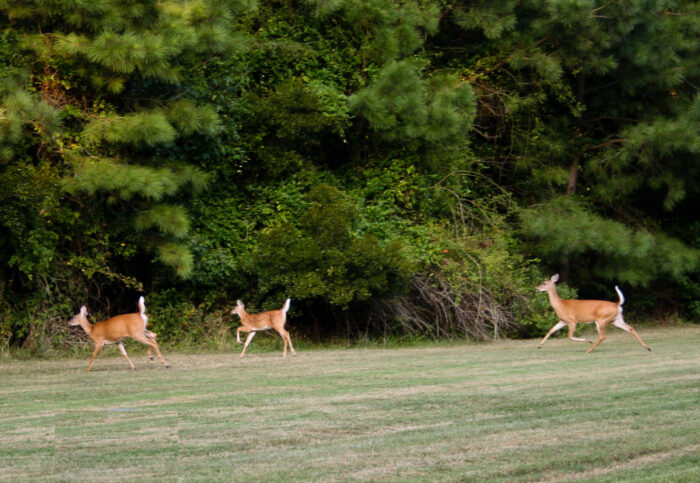
The white-tailed deer is a brownish, medium-sized deer. It is found in forests, farms, parks and backyards throughout the Chesapeake Bay watershed.
This section shows one large critter image at a time. Use the thumbnails that follow to select a specific image to display here.
This gallery contains a grid of small thumbnails. Selecting a thumbnail will change the main image in the preceding section.
Appearance
The white-tailed deer has a reddish-brown coat that turns grayish-brown in the winter. Its large tail is white underneath. Young (called fawns) have a reddish coat with white spots on the back. Males (bucks) have antlers that they shed in late winter and grow out in spring. Males grow to 5 feet in length and 3.5 feet tall at the shoulders, and can weigh 50 to 300 pounds. Females (does) are about one-third smaller.
Feeding
The white-tailed deer eats fruits and vegetation that are available to them each season. In spring and summer, it feeds on green plants such as leaves and aquatic vegetation, and fruit such as apples and berries. In autumn, it feeds on nuts, acorns and crops such as corn and soybeans. In winter, it feeds on woody vegetation such as bark, twigs and buds of hardwood and pine trees.
Predators
Humans are the white-tailed deer’s only major predator. Bobcats, wolves and coyotes used to be major predators but populations of these carnivores have fallen significantly.
Voice
White-tailed deer produce several types of vocalizations such as grunts, wheezes, and bleats. These vocalizations, along with other sounds and postures, are used for communication. Injured deer utter a startlingly loud "blatt" or bawl. Whistles or snorts of disturbed white-tailed deer are the most commonly heard sounds.
Reproduction and life cycle
Mating occurs during rutting season, which extends from late September to February, with a peak in November. Most deer begin mating around 18 months old, although some females mate as young as 7 months old. Bucks fight each other by clashing antlers to determine who can mate with a particular female. Does give birth after about 6.5 months (between May and June).
They usually have only one fawn the first year, but may have twins or triplets in following years if food is plentiful. Fawns can walk at birth. Fawns are weaned at 8 to 10 weeks old but begin to graze before this time. They stay close to their mother while foraging, except when she is out in the open, when fawns will hide by lying very still on the forest floor.
Male fawns may stay with their mother for one year, while females fawns stay for two years. Bucks begin growing their first rack of antlers in the spring following their birth. Deer can live to 16 years in the wild, but usually only lives about 2 to 3 years and rarely past 10 years.
Did you know?
- Also known as the Virginia deer, the white-tailed deer gets its name from the white underside of its tail, which it will raise like a flag when alarmed.
- They are remarkably good swimmers and agile runners that are capable of reaching speeds of 35 miles per hour and jumping 30 feet horizontally and 8.5 feet vertically.
- These deer have become overabundant in some areas because of their lack of predators, flexible feeding habits and ability to adapt to areas settled by humans.
- Bucks begin to shed the skin on their antlers, called velvet, in autumn due to lessening light, which causes bucks to produce more testosterone. In spring, increasing light triggers bucks to begin growing new antler buds, which push out old antlers just like adult teeth push out baby teeth in humans.
Sources and additional information
- Chesapeake Bay: Nature of the Estuary, A Field Guide by Christopher P. White
- Wildlife Information: White-tailed Deer – Virginia Department of Wildlife Resources
- Animal Diversity Web: Odocoileus virginianus – University of Michigan Museum of Zoology
- Odocoileus virginianus – U.S. Forest Service