
American Bullfrog
(Lithobates catesbeianus)
The American bullfrog is the largest frog species in North America, known for its booming call, powerful jumping legs, and voracious appetite.
This section shows one large critter image at a time. Use the thumbnails that follow to select a specific image to display here.
This gallery contains a grid of small thumbnails. Selecting a thumbnail will change the main image in the preceding section.
Appearance
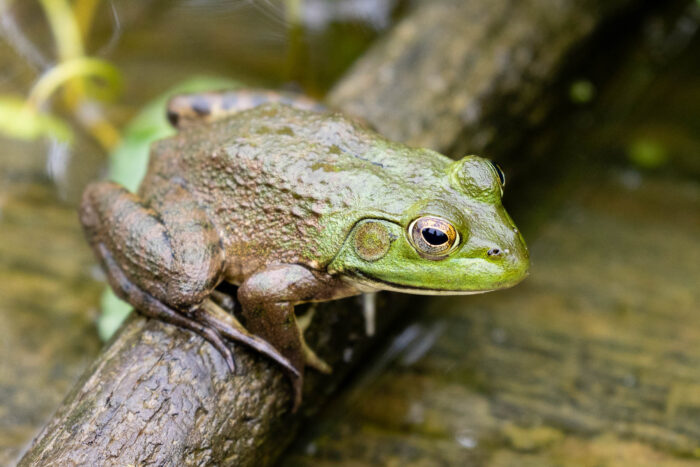
American bullfrogs are large, heavy-bodied frogs with smooth green to olive-brown skin often mottled with darker blotches on the back and legs. They have pale underbellies and a prominent fold of skin (tympanic fold) that curves around each large circular eardrum.
Males are generally smaller than females but have larger tympanums relative to eye size, and their throats often appear bright yellow during the breeding season. Bullfrogs have long, muscular hind legs with fully webbed back feet for powerful swimming and jumping. Their eyes are positioned high on the head, allowing them to stay mostly submerged while watching for prey.
Feeding
Bullfrogs are ambush predators that sit still at the water’s edge and lunge at passing prey with lightning-fast strikes of their sticky tongues. They consume a wide variety of animals, including insects, crayfish, fish, small snakes, other frogs, and even small birds and mammals. They do not chew food; instead, they swallow prey whole, often using their front feet to push food into their mouths. Tadpoles are mostly herbivorous, scraping algae and plant material from surfaces, though larger ones will occasionally eat small aquatic invertebrates.
Predators
Bullfrog eggs and tadpoles are eaten by fish, dragonfly larvae, turtles, and wading birds. Juveniles and adults may be preyed on by herons, snakes, snapping turtles and raccoons. Bullfrogs often avoid predators by diving into the water and hiding in muddy bottoms or thick vegetation, using their powerful legs to quickly escape.
Voice
Male bullfrogs produce a deep, resonant “jug-o-rum” croak that can carry for more than half a mile. They call mainly during the breeding season, especially on warm summer nights, and often form loud choruses around ponds and wetlands. Their calls are used to attract females and to defend territories from rival males.
Reproduction and life cycle
Bullfrogs breed in late spring through midsummer when water temperatures warm. Males establish territories and call to attract females, who can lay up to 20,000 eggs in large floating masses on the water’s surface. Eggs hatch in 3–5 days, and tadpoles may take one to three years to transform into adult frogs, depending on water temperature and food availability. After metamorphosis, juvenile bullfrogs grow rapidly, reaching sexual maturity in two to four years, and may live 7–9 years in the wild.
Did you know?
- American bullfrogs are known to be cannibalistic and will eat smaller bullfrogs, including their own young.
- They can leap more than 3 feet in a single bound thanks to their powerful hind legs.
- Though native to the eastern U.S., bullfrogs have been introduced to western states and many other countries, where they are considered an invasive species that can outcompete or eat native amphibians.
Sources and additional information
- American Bullfrog - Virginia Department of Wildlife Resources
- Field Guide to Maryland's Frogs and Toads (Order Anura) - Maryland Department of Natural Resources
- Create Feature: American Bullfrog - Penn State