
American Robin
(Turdus migratorius)
As one of the most common birds in the Chesapeake region, American robins can often be heard singing right outside your window.
This section shows one large critter image at a time. Use the thumbnails that follow to select a specific image to display here.
This gallery contains a grid of small thumbnails. Selecting a thumbnail will change the main image in the preceding section.
Appearance
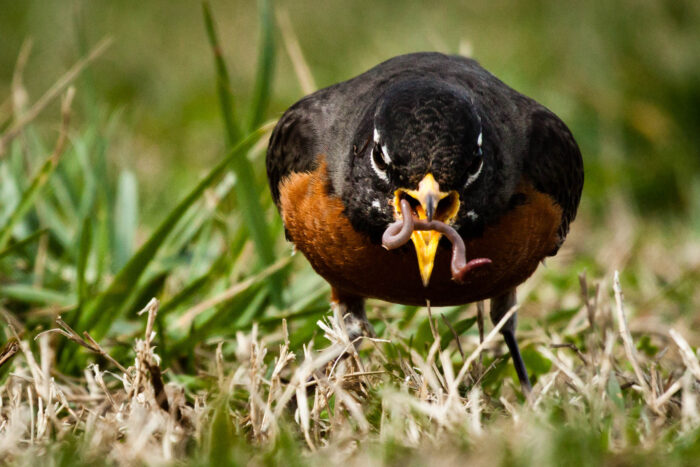
The American robin is a relatively large songbird with a round body, long legs and long tail feathers. They have dark gray-brown coloring with an easily identifiable rust-colored belly. Small white streaks can usually be spotted on the chin as well as spots around the eyes.
Feeding
American robins do much of their foraging on the ground on open lawns and parks. They eat mostly insects, fruit and earthworms. While fruit such as wild berries accounts for much of their diets, juveniles are fed mostly on insects and earthworms.
Predators
Some of the predators to adult robins include hawks, snakes and cats. Squirrels, snakes and other birds have also been known to eat the eggs and chicks.
Voice
The song of the American robin is a series of high-pitched notes that sound like cheer-up, cheer-a-lee, cheer-ee-o.
Reproduction and life cycle
In early stages of courtship, males will arrive at nesting grounds and defend their territory by singing or fighting. Once females have chosen their mate, breeding will take place from April through July. During the breeding season, males and females will form pair bonds that continue while they raise their young. American robins can have two or three sets of young in the course of one breeding season, with each clutch consisting of three to five eggs, which incubate for about two weeks before hatching. After hatching, both parents will feed the young and aggressively defend the nest. Most young leave the nest about 2 weeks after hatching.
Did you know?
- The American robin lays light blue eggs that inspired the “robin’s egg blue” crayon and paint colors
- Fruit accounts for about 60% of the American robin’s yearly diet
- American robins can become intoxicated when they eat honeysuckle berries exclusively
Sources and additional information
- American Robin - CornellLab All About Birds
- American Robin - National Audubon Society
- American Robin - National Wildlife Federation
- Meet the American Robin - Sacramento Audubon Society