
American Woodcock
(Scolopax minor)
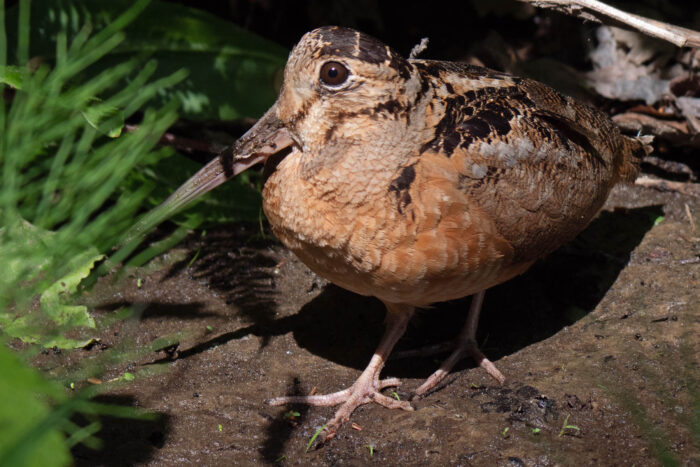
The American woodcock is a small, round shorebird with earth-toned plumage to help camouflage itself. Their unique mating call is one of the first signs of spring in the Chesapeake region.
This section shows one large critter image at a time. Use the thumbnails that follow to select a specific image to display here.
This gallery contains a grid of small thumbnails. Selecting a thumbnail will change the main image in the preceding section.
Appearance
The American woodcock is a short, round-bodied bird with a long bill. These birds have a camouflage black and brown pattern on their backs and a slightly orange belly on its mostly tan colored body.
Feeding
The American woodcock will probe its long bill into soft soil to forage for its prey. The tip of their bill is sensitive and flexible, making it easier to detect and grab creatures in the soil. Their diet includes earthworms, insects and other small invertebrates.
Predators
American woodcocks are often prey to domestic dogs and cats, snakes, skunks, opossums, raccoons and crows.
Voice
American woodcocks often make a loud, buzzy bzeep-bzeep call. Mating calls are often a more aggressive and repetitive peent-peent sound.
Reproduction and life cycle
From mid-March to early April, male woodcocks perform displays of courtship in open areas. After they have selected their mates, female woodcocks will lay a clutch of 4-5 eggs which will be incubated for 19-22 days. After hatching, the mother will feed the young for about a week, but juveniles start foraging for food on their own after about 3-4 days. About a month later, they will become fully independent. Male woodcocks will often mate with multiple females each breeding season and provide no parental care.
Did you know?
- The male woodcock's display of courtship (often taking place in the evening) is one of the most elaborate natural shows taking place in the early spring. After repeated calls, he will fly about 300 ft upwards in a spiral, and then dive down in a zig-zag pattern, landing right next to his chosen female.
- American woodcocks have large eyes that are positioned high and near the back of their skull in order to keep watch from danger in the sky while they have their heads down probing in the soil for food.
- The woodcock is also known as the timberdoodle, Labrador twister, night partridge and bog sucker.
Sources and additional information
- American Woodcock - Cornell Lab All About Birds
- Woodcock - Maryland Department of Natural Resources
- American Woodcock - Audubon
- Woodcock Facts - Ruffed Grouse Society