
Black Willow
(Salix nigra)
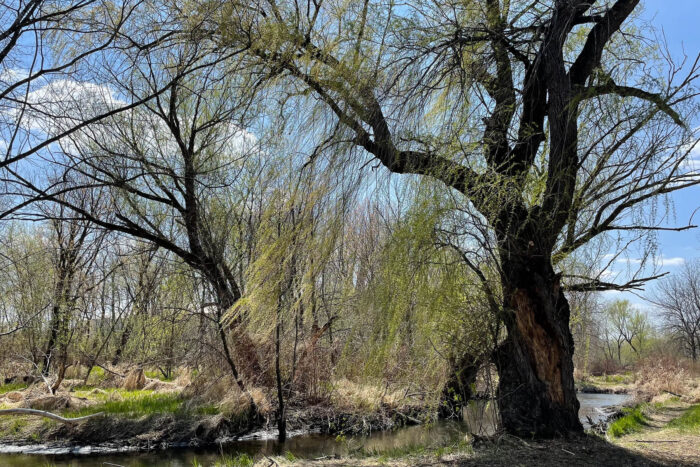
Growing along streams and riverbanks, the black willow has dark and long, narrow leaves.
This section shows one large critter image at a time. Use the thumbnails that follow to select a specific image to display here.
This gallery contains a grid of small thumbnails. Selecting a thumbnail will change the main image in the preceding section.
Appearance
Black willow is a medium to large willow with dark brown to nearly black bark that becomes furrowed with age. Leaves are narrow with serrated edges, either green or yellowish-green. The tree produces hanging clumps of yellowish-green flowers called catkins. Several trunks grow out at angles from one root.
Reproduction and life cycle
During spring, black willow seeds disperse on wind and water, germinating once they reach soil. Trees commonly begin producing viable seeds around age 8–10 years, but they also reproduce vegetatively where the tree sprouts from roots and stumps. Typical lifespan is often near 65 years, though many stems decline or die sooner in unstable environments.
Did you know?
- The genus name Salix is the classical Latin word for willow, and nigra means “black,” referring to its dark bark.
- Black willow is the largest willow with the most extensive range.
- Its branches root easily when buried in moist soil, which makes black willow a popular choice for streambank stabilization and erosion control projects.
Sources and additional information
- Black Willow - Case Trees
- Black Willow - Lady Bird Johnson Wildflower Center
- Black Willow - Pennsylvania Natural Heritage Program