
Downy Woodpecker
(Picoides pubescens)
The downy woodpecker is the smallest woodpecker in North America. They pick insects out of trees with their stubby beaks.
This section shows one large critter image at a time. Use the thumbnails that follow to select a specific image to display here.
This gallery contains a grid of small thumbnails. Selecting a thumbnail will change the main image in the preceding section.
Appearance
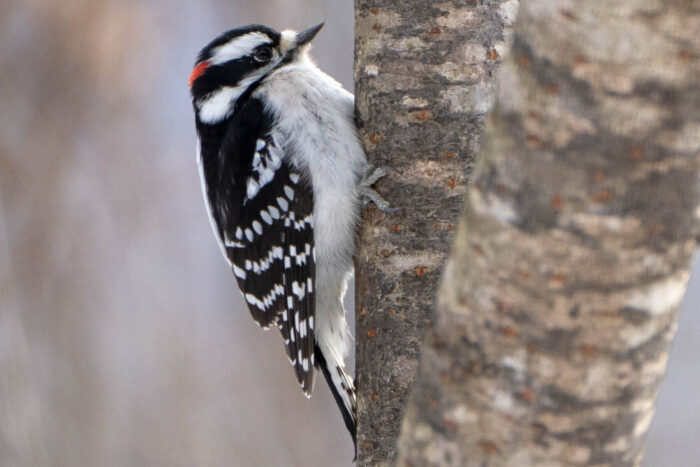
Smaller than most woodpeckers, downy woodpeckers have a white underside and black wings with white spots. Their faces are striped black and white. They have stubby beaks that are disproportionately smaller than other woodpeckers. Adult males have a small red patch on the back of their head.
Feeding
Downy woodpeckers spend much of the day foraging. They move up and down trees trying to pick insects out of bark. They also feed on garden pests.
Predators
Raptors like Cooper's hawks and peregrine falcons, as well as snakes, foxes and raccoons.
Flight
Downy woodpeckers are acrobatic flyers that move in an undulating pattern with quick wing beats.
Voice
Downy woodpeckers have a brief, high-pitched call.
Reproduction and life cycle
In late winter, downy woodpeckers form pairs and then excavate a nest from a dead tree. After the nest is built, females lay three to eight eggs that both males and females incubate. Nestlings hatch after about 12 days and fledge within 18-21 days.
Did you know?
- Downy woodpeckers are the smallest North American woodpecker.
- Downy woodpeckers are named for their soft back feathers.
- Downy woodpeckers look similar to hairy woodpeckers but have smaller beaks.
Sources and additional information
- All About Birds – The Cornell Lab of Ornithology
- Maryland Birds – Maryland Department of Natural Resources
- Downy Woodpecker – National Park Service
- Downy Woodpecker – National Audubon Society