
Golden-crowned Kinglet
(Regulus satrapa)
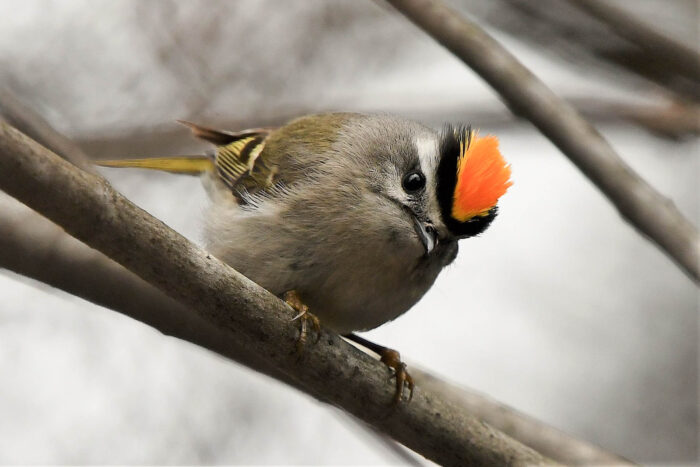
The golden-crowned kinglet is a tiny bird with a colorful crown that is used to express excitement, fear and interest during courtship.
This section shows one large critter image at a time. Use the thumbnails that follow to select a specific image to display here.
This gallery contains a grid of small thumbnails. Selecting a thumbnail will change the main image in the preceding section.
Appearance
Golden-crowned kinglets are one of the smallest birds in North America. Their backs and wings are a pale olive color and their bellies and breasts are light gray. They have a black stripe running through each eye and two black stripes on the top of their heads line their bright yellow crowns. Adult males have a fiery orange center to their yellow crown.
Feeding
Golden-crowned kinglets forage for insects in trees or shrubs. They rarely hold still, flitting, hovering and hanging upside down to pluck insects off branches or pine needles. They also display “hawking behavior,” during which the kinglet will briefly leave a perch to snatch an insect from the air before perching back in the same location or a nearby perch.
Predators
American red squirrels and sharp-shinned hawks are their primary predators, though blue jays and gray jays, eastern screech owls and bobcats have all been reported preying on golden-crowned kinglets.
Flight
Golden-crowned kinglets spend most of their time in tree canopies, during which they flit between branches with an often fast and erratic flight pattern.
Voice
Their song consists of two parts; a rising series of high, thin notes – described sometimes as zee-zee-zee or ti-ti-ti – followed by tumbling chatter.
Reproduction and life cycle
Golden-crowned kinglet nests are small cups made of lichen or moss lined with a layer of feathers to add warmth. They will also use moth cocoons, deer hair and spiderwebs to construct the nest. They typically lay three to eleven eggs, making for quite large broods compared to the average bird. Some individuals migrate south for the winter, while others stay put and brave the harsh, cold winters of the north.
Did you know?
- Golden-crowned kinglets participate in “interspecies mobbing”, during which they join a different bird species to aggressively harass a potential predator, usually a much larger bird. They most often ally themselves with black-capped chickadees.
- We still don’t know for sure how golden-crowned kinglets survive harsh winter nights. They have been found huddling with other kinglets at night to share warmth and may also use a strategy called nocturnal hypothermia, during which they conserve energy by strategically lowering their body temperature.
- When golden-crowned kinglets are first born they are the size of a bumblebee and featherless except for tufts of down on the top of the head.
Sources and additional information
- Golden-crowned Kinglet - Cornell Lab
- Golden-crowned Kinglet - American Bird Conservancy
- Golden-crowned Kinglet - Audubon
- Golden-crowned Kinglet - Animal Diversity
- Kinglets in the Cold - Vermont Center for Ecosystem Studies
- Golden-crowned Kinglet - Sibley Field Guide to Birds of Eastern North America
- Firecrests and Kinglets - The Princeton Encyclopedia of Birds
- Heinrich, Bernd (June 2003). "Overnighting of Golden-Crowned Kinglets During Winter". The Wilson Bulletin. 115 (2): 113–114. doi:10.1676/03-035.