
Japanese Barberry
(Berberis thunbergii)
Native to Japan, Japanese Barberry has spread widely across North America since its introduction as an ornamental shrub in the 1800s.
This section shows one large critter image at a time. Use the thumbnails that follow to select a specific image to display here.
This gallery contains a grid of small thumbnails. Selecting a thumbnail will change the main image in the preceding section.
Appearance
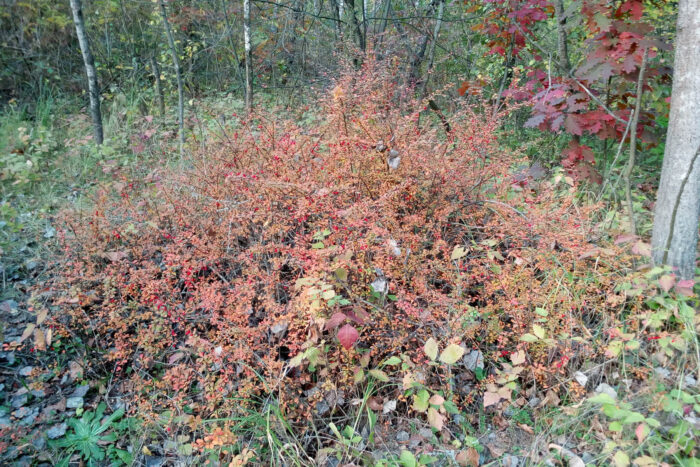
Japanese barberry is a small, spiny deciduous shrub with arching branches and small, oval leaves that turn bright red, orange or purple in the fall. Its leaves are smooth and arranged in clusters along green to reddish stems lined with sharp single thorns. In spring, it produces small yellow flowers that dangle beneath the stems, followed by bright red berries that persist into winter. The shrub’s dense, rounded form and vivid seasonal color make it easily recognizable in both gardens and wild landscapes.
Reproduction and life cycle
Japanese barberry reproduces primarily through seed dispersal by birds that eat its berries. Each shrub can produce hundreds of berries annually, which ripen in late summer and persist through winter. Seeds germinate easily in spring, and the plant can also spread vegetatively when stems contact soil. Once established, it forms dense thickets that prevent other plants from growing.
Did you know?
- The scientific name thunbergii honors Swedish botanist Carl Peter Thunberg.
- Japanese barberry was introduced to the U.S. in the late 1800s as a substitute for common barberry, which carried wheat rust.
- The plant alters soil pH and increases tick habitat, raising the risk of Lyme disease in infested areas.
- Removing barberry can help restore native understory plants and reduce tick populations.
Sources and additional information
- Just Say No to Invasive Barberry - Fairfax County Master Gardeners
- Japanese Barberry - Master Gardeners of Northern Virginia
- Japanese Barberry - Maryland Extension