
Marsh rice rat
(Oryzomys palustris)
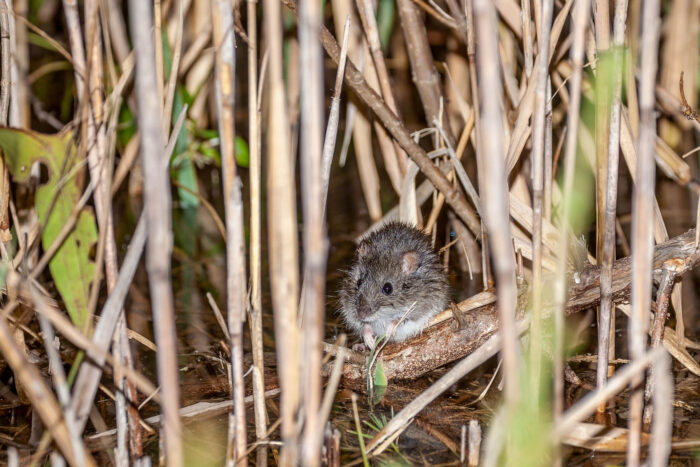
The marsh rice rat is a grayish-brown rodent with a long tail. It lives in tidal marshes near the Chesapeake Bay in Delaware, Maryland and Virginia.
This section shows one large critter image at a time. Use the thumbnails that follow to select a specific image to display here.
This gallery contains a grid of small thumbnails. Selecting a thumbnail will change the main image in the preceding section.
Appearance
The marsh rice rat has a long, slender body covered in coarse, grayish-brown fur with some blackish hairs. Its scaly tail is usually longer than its head and body (about 7 inches long). Its belly, feet and the underside of its tail are light grayish or whitish. These rats grow to about 5 inches long and weigh less than 3 ounces.
Feeding
An opportunistic feeder, the march rice rat eats whatever is available, including insects, snails, fishes, bird eggs and fiddler crabs as well as grasses, sedges and aquatic plants.
Predators
Owls are a major predator. Other predators may include hawks, minks, weasels, raccoons, foxes and snakes. These rats will often dive underwater when threatened.
Reproduction and life cycle
Breeding occurs several times between March and October. Females can produce several litters of 3 to 5 young each year. The marsh rice rat builds a softball-sized nest of woven grasses and sedges in hidden areas above the high-tide mark. Gestation lasts about 25 days.
Young are born blind and helpless; by early in their second week of life, young open their eyes and are able to eat solid food. Females reach sexual maturity within six weeks of age. Marsh rice rats usually do not live longer than one year.
Did you know?
- The marsh rice rat is a skilled swimmer that is able to dive more than 30 feet deep and swim across nearly 1,000-foot stretches of water.
- They prefer to live in areas with plenty of grasses and sedges. Marsh rice rats are semi-aquatic, spending time both on the land and in the water and are mostly nocturnal.
- Their undercoats are water-repellant.
- Marsh rice rats will occasionally take over the nests of blackbirds for their own use.
Sources and additional information
- Wildlife Information: Marsh Rice Rat – Virginia Department of Game & Inland Fisheries
- Marsh Rice Rat - Northa Carolina State University