
Purple Pitcher Plant
(Sarracenia purpurea)
The purple pitcher plant is a carnivorous plant with hollow, pitcher-like leaves and a disc-like flower that blooms from late spring to mid-summer.
This section shows one large critter image at a time. Use the thumbnails that follow to select a specific image to display here.
This gallery contains a grid of small thumbnails. Selecting a thumbnail will change the main image in the preceding section.
Appearance
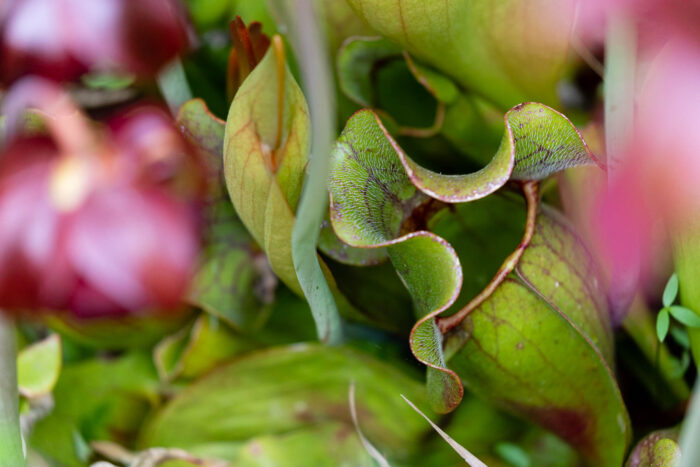
The purple pitcher plant features a cluster of bronzy, reddish-green leaves that are often tinged or veined with purple. The leaves are hollow, lipped and curved like a pitcher, allowing the leaves to collect water. When flowering, the plant pushes a single, large purplish-red flower on a leafless stalk shaped like a thick, flat disc ringed with dark, maroon petals.
Feeding
The purple pitcher plant traps its prey using its hollow, pitcher-like leaves, which fill naturally with rainwater. When prey crawl into the pitcher, stiff, downward-pointing hairs prevent them from escaping, thereby causing them to drown. Pitcher plant leaves digest their drowned prey by producing digestive enzymes, but they also receive help from a community of bacteria, microinvertebrates and mosquitoes that digest the trapped prey, making nutrients available to the plant. The relationship between the organisms that aid the pitcher plant’s digestion and the pitcher plant itself is an example of mutualism.
Predators
Across the United States, the caterpillars of three different moth species feed on the purple pitcher plant. Only one of these moth species, the epauletted pitcher plant moth, lives as far north as the Chesapeake Bay watershed. The caterpillars of the epauletted pitcher plant moth feed on the inner surface of the tubular leaves.
Reproduction and life cycle
Purple pitcher plants can live for 20 to 30 years, producing new pitcher-like leaves each year that remain evergreen unless disturbed. They begin flowering in early to mid-March along the Gulf Coast, and in late spring in the Chesapeake region. Bees are their main pollinators. Purple pitcher plant seeds are typically dispersed no farther than 2 inches from the original plant.
Did you know?
- Native American and First Nation tribes used the dried roots of purple pitcher plants to make an herbal tea that was reportedly effective at treating smallpox. Recent scientific studies have shown that purple pitcher plants do successfully inhibit poxvirus replication.
- Two small insects are found only inside the water-filled leaves of the purple pitcher plant: the pitcher plant midge and the pitcher plant mosquito. They feed on decaying invertebrate carcasses.
- The purple pitcher plant is not a very efficient predator. Only 1% of visiting prey are captured within the pitcher.
Sources and additional information
- Sarracenia purpurea - U.S. Forest Service
- Meadowview Biological Research Station - Virginia Department of Wildlife Resources
- Carnivorous plants eat far more salamanders than scientists thought - National Geographic
- Pitcher-Plant Midges and Mosquitoes: A Processing Chain Commensalism - Ecology
- Sarracenia purpurea - Lady Bird Johnson Wildflower Center
- Purple Pitcher Plant (Sarracenia purpurea) - iNaturalist
- In Vitro Characterization of a Nineteenth-Century Therapy for Smallpox - Plos One