
Snowberry clearwing
(Hemaris diffinis)
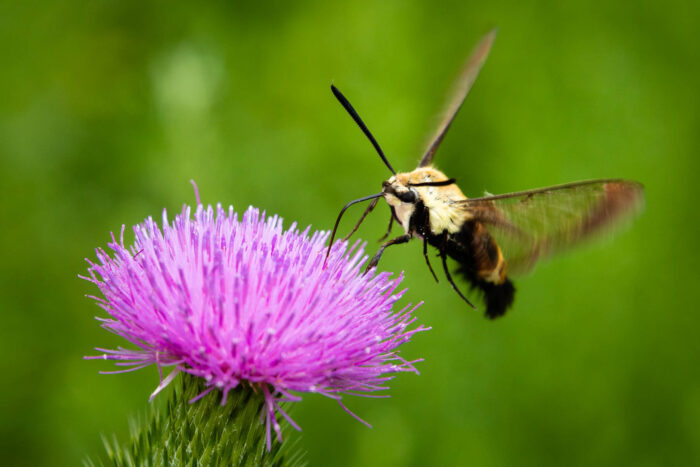
The snowberry clearwing is a type of hummingbird moth that can be found throughout the Chesapeake Bay region. It is a pollinator that hovers in front of flowers to drink nectar.
This section shows one large critter image at a time. Use the thumbnails that follow to select a specific image to display here.
This gallery contains a grid of small thumbnails. Selecting a thumbnail will change the main image in the preceding section.
Appearance
The snowberry clearwing has a stocky body about one to 1.5 inches in length. It has a broad, furry, yellow thorax and a black body with reddish-brown wings covered in scales. They often lose these scales, which gives their wings a transparent appearance—hence the name clearwing. It can be distinguished from other hummingbird moths by its black legs and the black band along the side of its thorax.
Feeding
When feeding from a flower, the snowberry clearwing uses a proboscis: a straw-like tongue that unfurls from underneath its chin, allowing it to reach nectar from deep inside a flower where other insects cannot reach. It hovers in front of the flower rather than landing on it. They don’t rely on a specific plant for their nectar—rather, they feed from a variety of flowers.
Predators
The snowberry clearwing’s yellow and black coloration mimics bumble bees. This mimicry helps fool potential predators into thinking the clearwing might sting.
Flight
Snowberry clearwings can look like hummingbirds in flight. Their rapid wingbeats allow them to hover in front of flowers and cause a similar humming sound.
Reproduction and life cycle
Snowberry clearwings lay their eggs on plants that their larvae can eat. The eggs hatch into caterpillars, which g Caterpillars make their cocoons on the ground in leaf litter. They pupate throughout the winter months and emerge in late spring.
Did you know?
- The snowberry clearwing is sometimes known as the flying lobster moth due to its strange appearance.
- The snowberry clearwing takes its name from the snowberry plant, a deciduous shrub in the honeysuckle family. As a caterpillar, the clearwing is especially fond of the snowberry, snacking on its leaves and using it as a host when constructing its cocoon.
- Hummingbird moths like the snowberry clearwing are members of the sphinx moth family.
Sources and additional information
- Pollinators: Hummingbird Moth – U.S. Forest Service
- Nature and Wildlife: Hummingbird Moth – Mass Audubon
- Field Guide: Snowberry Clearwing – Missouri Department of Conservation