
Trout Lily Bee
(Andrena erythronii)
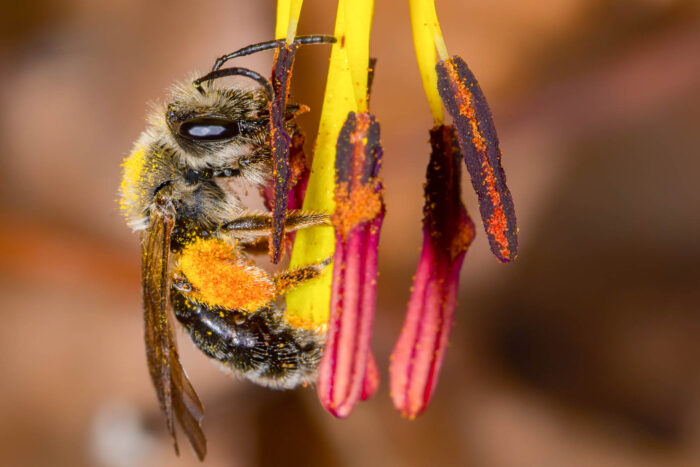
The trout lily bee is a large mining bee that feeds on the nectar of trout lily flowers.
This section shows one large critter image at a time. Use the thumbnails that follow to select a specific image to display here.
This gallery contains a grid of small thumbnails. Selecting a thumbnail will change the main image in the preceding section.
Appearance
The trout lily bee is a relatively large bee that is recognizable from their medium-long hairs that are brown on the thorax and create stripes on the abdomen.
Feeding
The trout lily bee feeds almost exclusively on the nectar of the trout lily blossom, hence its name. While not its flower of choice, the bee will also feed on the nectar of the Virginia spring beauty and a few other flower species.
Predators
Birds, reptiles, mammals and large insects are all common predators of the trout lily bee.
Reproduction and life cycle
Trout lily bees reproduce through internal fertilization once a year, coinciding with the season of blooming trout lilies. Male trout lily bees will die shortly after mating, while the female will build an underground nest that has individual chambers for each egg. The female will then lay the egg along with placing a ball of pollen as a food source for the developing larva and the egg will hatch within a few days. Larvae will remain underground through the summer, fall and winter and pupate into adults by late winter or early spring.
Did you know?
- Trout lily bees are miner bees, meaning they are solitary, ground nesting bees. Unlike bees who form colonies and have a queen, females will excavate tunnels in the soil for individual nesting.
- The trout lily bee is very similar to the long-lipped mining bee, differing mainly in color.
- Because they emerge only to collect the nectar of the trout lily flower, the lifespans of adult trout lily bees are only long enough to complete this task and find mates. Most adults only live up to 6 weeks.
Sources and additional information
- Trout-lily Mining Bee (Andrena erythronii) - Vermont Center for EcoStudies
- Trout-lily Mining Bee - iNaturalist
- Andrena erythronii - NatureServe Explorer
- Thinking of Spring (Part 2): The Ecological Role of Spring Ephemerals - Edge of the Woods Native Plant Nursery