
Three pirate tales that took place on the Chesapeake Bay
Climb aboard the ship of a pirate to learn how Blackbeard, the Davis trio and others carved out their own slice of Bay history.
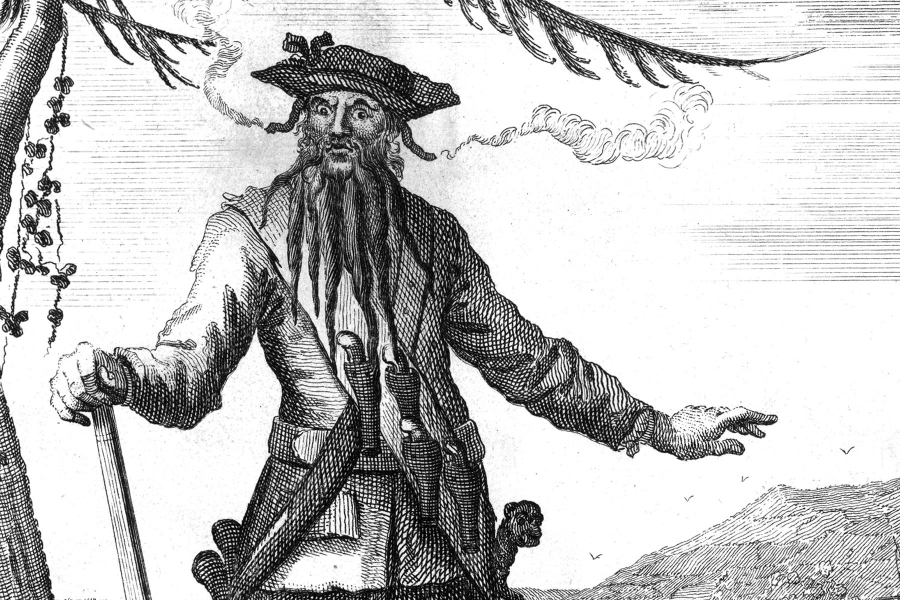
The life of a pirate was mostly spent out on the ocean or coastal waters where they had a chance of robbing large ships filled with valuable goods to sell. However, as colonial life expanded in Maryland, Virginia and Delaware during the 16th and 17th century, plenty of hardened pirates visited the Bay, either preparing to set sail or laying low after a big score. Below are three tales of notable pirates who crossed paths with the estuary and its residents.
Pirate trio’s confiscated loot funds Virginia college
Davis, Wafer and Hinson were three legendary pirates who plundered the South Seas as a threesome. After five years of piracy, the group settled in Virginia to hide from all of those that they had robbed. The trio traveled over land from Delaware Bay to the head of the Chesapeake, then headed down the Bay in a shallop. But before they could complete their trip, Captain Rowe of the Dumbarton captured them and threw them in the Jamestown jail for a year. Davis, Wafer and Hinson petitioned the Virginia council several times to return their confiscated treasures. Finally, in 1692, the King of England proclaimed that their loot would be returned. However the King kept 300 pounds, and used it to found the College of William and Mary.
Pirate on the run gets arrested on the Severn River
In 1699, officials in England ordered the arrest of William Kidd and his fellow pirates after having captured several European ships near Madagascar and in the Red Sea. Kidd soon arrived on the Delaware coast, where some of his crew left the ship, including the young Theophilus Turner. While on the run, Turner fled to the Tidewater area to lay low. However, an agent of the governor of Maryland caught Turner on the Severn River, and he was sent back to England for trial and his treasure was confiscated. If you’re curious what happened to Kidd: he was also arrested while sailing for Boston, sent back to England and hanged in 1701.
The infamous Blackbeard attempts to settle down in Virginia
Of all pirates, Edward Teach—better known as Blackbeard—is probably the most legendary. His untrimmed, braided beard extended from his eyes down to his chest. Like other pirates, Teach sometimes used the seclusion of the Eastern Shore to prepare his ship for sea. Though he traveled far and wide, Teach also found fertile pirating grounds in the area off the Virginia capes. In the fall of 1717, he and Captain Hornigold captured the sloop Betty off Cape Charles and plundered Madeira wine and other valuables.
By the summer of 1718, Teach decided to live the life of a "gentleman," settling in Bath, North Carolina, and marrying his 14th bride. His gentlemanly life was cut short when his nemesis, Governor Spotswood of Virginia, sent Captain Maynard to North Carolina for a duel.
After a bloody fight, Maynard prevailed and carried his prize—Blackbeard's head—back to Hampton, Virginia, on the bowsprit of his ship.
How's that for a pirate story?
Comments
There are no comments.
Thank you!
Your comment has been received. Before it can be published, the comment will be reviewed by our team to ensure it adheres with our rules of engagement.
Back to recent stories