
Brook Trout Workgroup
The Brook Trout Workgroup seeks to protect and enhance brook trout within the Chesapeake Bay watershed, increasing their occupancy, abundance and resilience to changing environmental conditions.
Meetings
Brook Trout Workgroup Fall Meeting - November 2026
Brook Trout Workgroup Meeting - May 2026
Brook Trout Action Team Meeting - November 2025
CANCELED: Habitat GIT Fall 2025 Meeting: Day 2 of 2
About
The Brook Trout Workgroup coordinates partners throughout the Chesapeake Bay watershed toward the goal of increasing brook trout-occupied habitat, increasing brook trout abundance at long-term monitoring sites and increasing the resilience of the strongest brook trout populations to environmental changes. Our membership includes state agencies in Maryland, New York, Pennsylvania, Virginia and West Virginia, as well as non-governmental organizations like the Eastern Brook Trout Joint Venture (EBTJV), Trout Unlimited and Western Pennsylvania Conservancy.
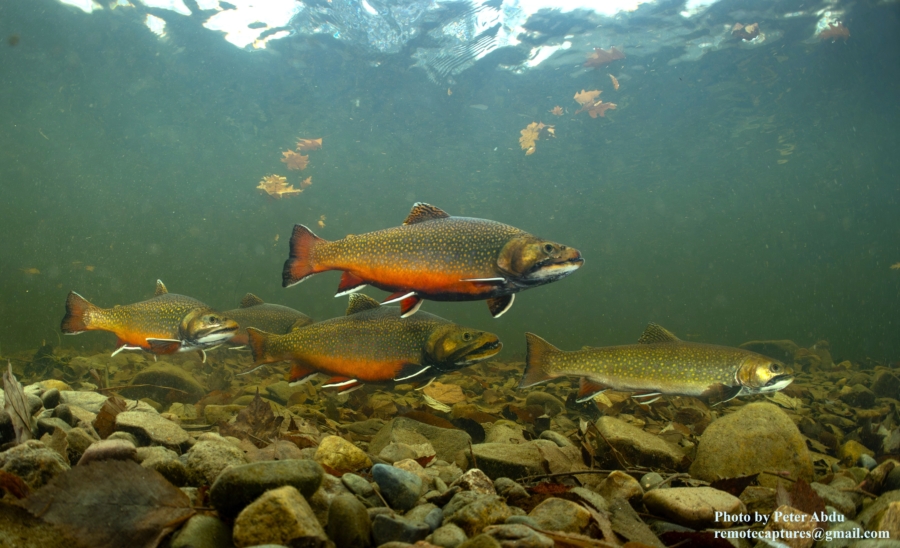
How Do We Track Progress?
In its work toward the Brook Trout Outcome, the Brook Trout Workgroup uses existing data from state and federal agencies, conservation districts and NGOs to determine brook trout-occupied habitat, monitor brook trout abundance and track the number of projects that are reducing major stressors to brook trout throughout the Chesapeake Bay watershed.
Determining How Much Habitat Is Occupied By Brook Trout
In order to understand how much cold-water habitat is occupied by brook trout, the Brook Trout Workgroup leans on the Eastern Brook Trout Joint Venture (EBTJV). EBTJV collects data from state agencies and uses a specialized algorithm to approximate occupancy throughout the watershed. It should be noted that the EBJTV Range-Wide Assessment is not currently well-suited to identifying site-specific occupancy changes over time, but is instead a tool to understand landscape-level changes in habitat occupancy.
The workgroup also sends data calls to our partners to track projects that have resulted in known gains and losses to brook trout populations and apply these to the EBTJV approximation to better estimate changes to occupancy over time.
Monitoring Abundance Trends Through Our BTAMSs Network
Understanding where brook trout are is crucial to understanding how we can implement management actions to increase their numbers. In 2025, the Brook Trout Workgroup committed to increasing brook trout abundance at at least 10 long-term monitoring sites. To do this, each state has designated two primary Brook Trout Abundance Monitoring Sites (BTAMSs) to observe how environmental changes and management actions affect brook trout populations. With a better understanding of what actions can be taken to increase brook trout abundance, we can ensure the best populations are thriving and expanding into new habitat.
Combating Environmental Stressors
Brook trout used to be much more prevalent in the Chesapeake Bay watershed, but because of both environmental and human-induced stressors, their numbers have significantly declined. We continue to see seasonal die backs of vulnerable populations and with storms and environmental changes only increasing in intensity, brook trout population stability is a growing concern.
However, the Brook Trout Workgroup has committed to combatting stressors by encouraging restoration and conservation work within "healthy brook trout watersheds” (see below for how these are defined) to reduce identified stressors by 15%. To track our progress we will compare the amount of restoration happening on the ground to the baseline extent of the five identified threats to brook trout.
Acid Mine Drainage
Brook trout are extremely sensitive to poor water quality. Both old and new mining operations leach heavy metals into the streams where brook trout live. This changes the water's pH and can kill brook trout or limit them from expanding into new habitat. AMD remediation projects can reduce the effect of acidic heavy metals and relieve stress on brook trout habitat.
Sediment Run-off from Dirt and Gravel Roads
Sediment from dirt and gravel roads can run into cold-water streams, impacting habitat quality and stream temperature, negatively affecting brook trout. Projects improving these roads would redirect sediment runoff from being deposited into brook trout habitat.
Deforestation In Cold-Water Habitat
Brook trout are a cold-water species and prefer temperatures less than 72°F (17°C). Reduction in shade from deforestation has decreased the amount of cold-water habitat that brook trout can reside. Ensuring proper stream shading from planting trees along the stream’s edge decreases stream temperatures and increases water quality.
Fragmented Habitat
Dams and roads that cross over streams can be barriers that separate brook trout populations and restrict migration into suitable habitat. Ensuring barrier-free streams allows brook trout to colonize new habitat, maintain population health (e.g. genetics, number of individuals, and more), and seek refuge from other stressors, increasing population resiliency.
Development
Urbanization of brook trout watersheds could be the most significant stressor to their populations. With urbanization comes more roads, less trees, more urban runoff, and decreased water quality. The best way to combat this is to protect lands near brook trout habitat so they are not developed in the future.
How Do We Define Healthy Brook Trout Watersheds?
A few of our outcome's targets specify work to be done in healthy brook trout watersheds, but how does the workgroup define these places? We utilize Trout Unlimited’s definition of brook trout strongholds and persistent patches.
Learn More
To learn more about brook trout, visit the Eastern Brook Trout Joint Venture website. To access state-specific brook trout action plans, restoration priorities or maps, refer to EBTJV’s agency management plans and maps.
Projects
Facilitating Brook Trout Outcome Attainability Through Coordination With CBP Jurisdictions and Partners
CompleteThis project populated a database to better evaluate progress toward the Chesapeake Bay Program's Brook Trout Outcome.
Publications
Determining Brook Trout Extirpation
Publication date:This document provides guidance for determining brook trout extirpation within previously occupied catchments of the Chesapeake Bay watershed.
View document [PDF, 101.8 KB] Determining Brook Trout Extirpation
Blueprint for Building Partnerships and Recommendations for Scaling Brook Trout Restoration in Stronghold and Persistent Patches
Publication date:This report summarizes two parallel STAC workshops held in DuBois, Pennsylvania, and Westminster, Maryland, to discuss the strategic implementation of priority best management practices to successfully recolonize, recover or repatriate brook trout populations.
Calculation Methodology for the Brook Trout Resiliency Target of Reducing Identified Threats by 15%
Publication date:This document describes the methodology used to calculate the current extent of threats to the resiliency of brook trout across the Chesapeake Bay watershed.
Classifying Healthy Brook Trout Watersheds
Publication date:This document explains how the Brook Trout Workgroup defines healthy brook trout watersheds, or watersheds that support healthy brook trout populations.
View document [PDF, 3.0 MB] Classifying Healthy Brook Trout Watersheds
Related Resources
-
Using Environmental DNA (eDNA) to Track Brook Trout Recovery in Tributaries of the Chesapeake Bay - Raza, 2024
A master's thesis on utilizing environmental DNA (eDNA) to monitor the recovery of brook trout in the tributaries of the Chesapeake Bay.
-
The Importance of Scale: Assessing and Predicting Brook Trout Status in its Southern Native Range - Hudy et al., 2013
A report on fine-scale occupancy data across the southern historic range of brook trout determines which landscape metrics and thresholds are useful in predicting brook trout presence across three relevant spatial scales and how brook trout occupancy varies by scale.
-
EBTJV Salmonid Catchment Assessment and Habitat Patch Layers - Coombs and Nislow, 2015
A step-by-step description of extending, standardizing and automating the salmonid status assessment.
-
Range-wide Assessment of Brook Trout at the Catchment Scale: A Summary of Findings - 2016
A revised summary of the EBTJV's range-wide assessment of brook trout at the catchment scale.
-
Distribution, Status and Land Use Characteristics of Subwatersheds within the Native Range of Brook Trout - Hudy et al., 2008
A report that examined and summarized existing knowledge regarding the distribution and status of self-sustaining populations of brook trout at the subwatershed scale.
Our Watershed Agreement Goals & Outcomes
Thriving Habitat, Fisheries & Wildlife Goal
Our Members
- Daniel Goetz (Chair)
Maryland Department of Natural Resources danielb.goetz@maryland.gov - Katie Ombalski (Chair)
katie@woodswaters.com - Chris Guy (Coordinator)
U.S. Fish and Wildlife Service (USFWS) chris_guy@fws.gov - Kami Lentzsch (Staffer)
Chesapeake Research Consortium Lentzsch.Kami@epa.gov