
Brown Pelican
(Pelecanus occidentalis)
The brown pelican is a large, dark-colored water bird that lives along the shores of the middle and lower Chesapeake Bay during summer.
This section shows one large critter image at a time. Use the thumbnails that follow to select a specific image to display here.
This gallery contains a grid of small thumbnails. Selecting a thumbnail will change the main image in the preceding section.
Appearance
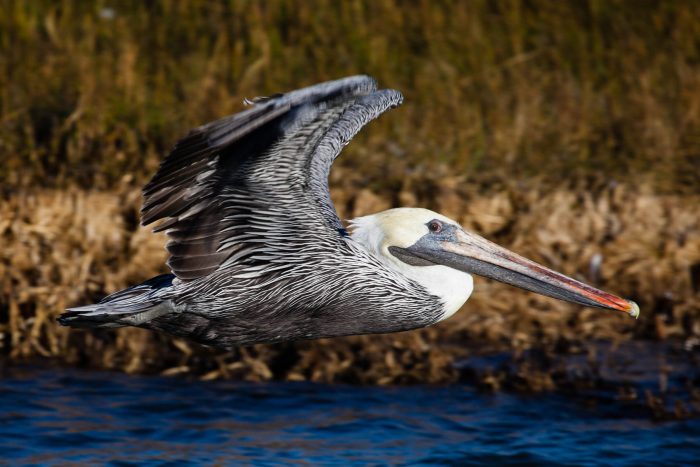
Brown pelicans grow to about 50 inches in length with a wingspan of 6 feet and weigh eight to ten pounds. Adults are mostly dark all over their body, with chesnut and white coloring on their neck and a pale yellow forehead. Their large, grayish bill is 9 to 15 inches in length, and there is an elastic throat pouch underneath the bill. Their legs and feet are grayish-black. Juveniles have a brown head and back with whitish underparks.
Feeding
This bird feeds primarily on fish such as menhaden, herring, sheepshead and silversides and can eat up to 4 pounds of fish per day. It hunts by flying high above the water to find a school of fish, then diving head-first into the water to catch its prey. After catching a fish underwater, pelicans hold it (and a lot of water) in their throat pouch. Once they surface, pelicans point their bill downward to allow the water to drain out and then tilt their bill upward to swallow the fish.
Predators
Brown pelicans have no natural predators; their biggest enemies are humans, who have decimated pelican populations in the past.
Flight
Flocks of brown pelicans fly in a long, straight line or a V formation with synchronized wingbeats and gliding. Sometimes a pelican will fly low over the water’s surface, almost touching it with its wingtips. It flies with its neck folded and head resting on its back.
Voice
Adults are silent, with a rare low croak; nestlings squeal.
Reproduction and life cycle
Breeding typically begins at age three to five years. Pelicans organize in large colonies on the ground, in bushes or in the tops of trees. The male brings nest materials to the female, who builds the nest. Females usually lay two to three chalky white eggs between March and May. Unlike most birds, pelicans incubate their eggs with their feet. Parents share the responsibility of incubating the eggs, which hatch in about a month, and raising the young. Pelicans are born blind, featherless and entirely dependent on their parents. First flight usually occurs around 75 days old.
Did you know?
- The brown pelican is the smallest pelican species in the world.
- Brown pelicans have excellent eyesight, giving them the ability to spot schools of fish from high up in the air.
- A pelican’s throat pouch can hold up to three times more than its stomach.
- Brown pelicans are very strong swimmers. Young pelicans have been tracked swimming three miles per hour before they are even able to fly.
- The use of the pesticide DDT in the mid-20th century caused populations of brown pelicans and other birds, including ospreys and bald eagles, to decline significantly. After DDT was banned in 1972, pelicans began to thrive again.
Sources and additional information
- Life in the Chesapeake Bay by Alice Jane Lippson and Robert L. Lippson
- Chesapeake Bay: Nature of the Estuary, A Field Guide by Christopher P. White
- Animal Diversity Web: Pelecanus occidentalis – University of Michigan Museum of Zoology
- All About Birds: Brown Pelican – The Cornell Lab of Ornithology
- NatureWorks: Brown Pelican – New Hampshire Public Television