
Ghost anemone
(Diadumene leucolena)
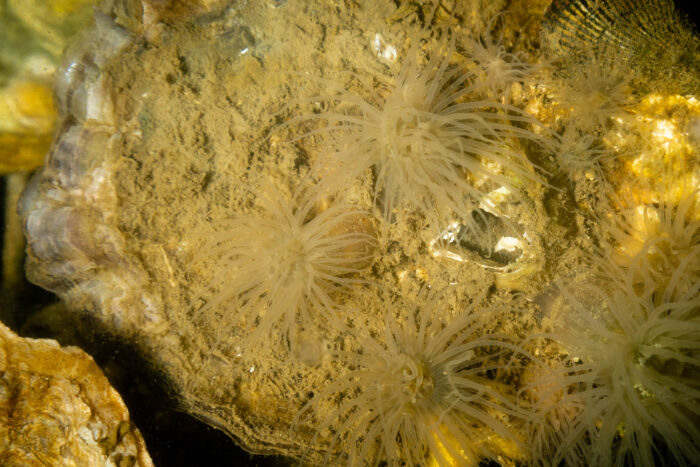
The ghost anemone is a jelly-like invertebrate with a flat, rounded base and stinging tentacles at the top of an elongated stalk. It lives on rocks, reefs, pilings and other hard surfaces throughout the Chesapeake Bay.
This section shows one large critter image at a time. Use the thumbnails that follow to select a specific image to display here.
This gallery contains a grid of small thumbnails. Selecting a thumbnail will change the main image in the preceding section.
Appearance
The ghost anemone grows to 1.5 inches tall and one-half inch wide. Its jelly-like, transparent body has a whitish or pinkish tint. It has a flat, rounded base and an elogated stalk, with a circle of 40 to 60 petal-like tentacles growing from the top. Its tiny mouth is in the center of this circle of tentacles.
Feeding
The ghost anemone eats plankton and tiny fish, using its stinging tentacles to stun and capture its prey, then push the prey into its mouth.
Reproduction and life cycle
Ghost anemones reproduce both sexually and asexually. Asexual reproduction takes place when a new, identical anemone sprouts from the base of the body. To reproduce sexually, anemones release eggs and sperm into the water. Eggs produce free-swimming larvae that eventually settle onto a hard surface.
Did you know?
- Ghost anemones are related to sea nettles. Just like the notorious jellyfish, anemones have stinging tentacles.
- Even though they are always attached to a hard surface, anemones can move relatively quickly—up to several inches in just a few hours.
- Ghost anemones move by manipulating the base of its body, similar to an inchworm.
Sources and additional information
- Life in the Chesapeake Bay by Alice Jane Lippson and Robert L. Lippson
- Diadumene leucolena – World Register of Marine Species