
Hogchoker
(Trinectes maculatus)
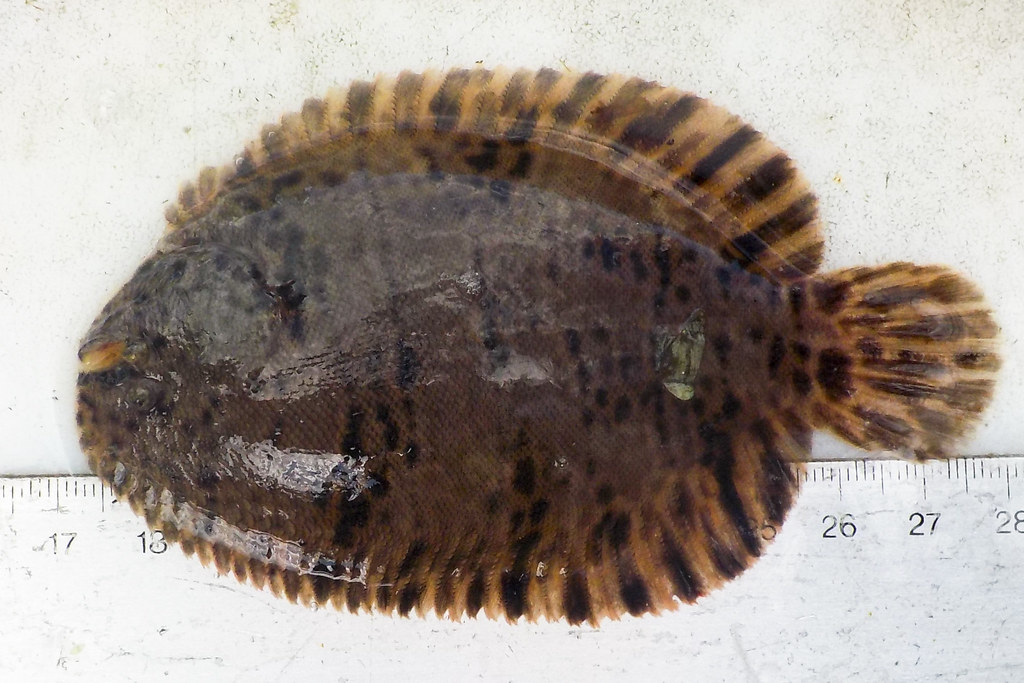
The unusually-named hogchoker is a small, flat fish with a brown, rounded body. It is abundant year-round throughout the Chesapeake Bay.
This section shows one large critter image at a time. Use the thumbnails that follow to select a specific image to display here.
This gallery contains a grid of small thumbnails. Selecting a thumbnail will change the main image in the preceding section.
Appearance
The hogchoker has a flat, rounded body that grows to about 6 inches in length. It is a dark brownish-gray on top and pale on the bottom, with narrow, black vertical lines or spots on the top side of its body. It has a rounded head with a small mouth. Both its small eyes are located on the top side of its body. Its dorsal and anal fins stretch around its body from its head to its rounded tail fin.
Feeding
Hogchokers eat worms and crustaceans. They hunt for prey by lying half-buried in bottom sediments with both eyes looking up.
Predators
The hogchoker conceals itself from predators by burying itself in bottom sediments and changing colors to blend in with its surroundings.
Reproduction and life cycle
Spawning occurs from May through September in inshore waters. Young are born with one eye on each side of the head. As larvae, the left eye gradually travels over the top of the head to a position next to the right eye. Hogchokers can live to 7 years old.
Did you know?
- The unusual name "hogchoker" comes from farmers who used to feed this fish to their hogs. The hogs would often have a hard time eating the fish’s scaly, bony body.
- The hogchoker is considered to be a "right-handed" flatfish because its mouth and eyes are on the right side of its body when viewed from above.
- It is nearly impossible to spot a hogchoker that has buried itself.
Sources and additional information
- Fishes of Chesapeake Bay by Edward O. Murdy, Ray S. Birdsong and John A. Musick
- Life in the Chesapeake Bay by Alice Jane Lippson and Robert L. Lippson
- Hogchoker – Virginia Institute of Marine Science