
Loblolly Pine
(Pinus taeda)
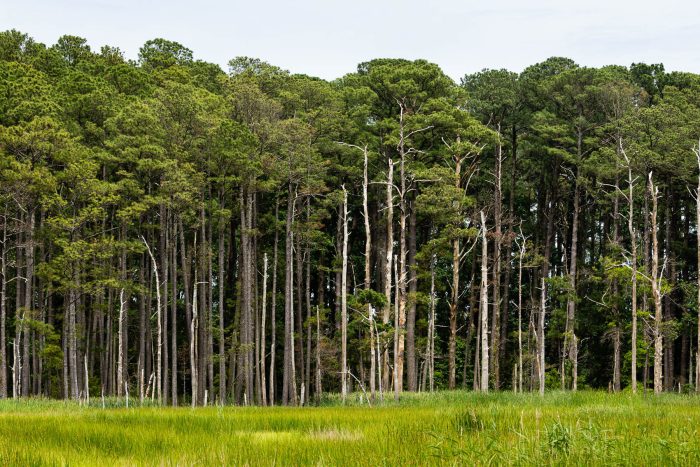
The loblolly pine is a tall evergreen tree with long, thin needles and scaly bark. It grows along the edges of the Chesapeake Bay and its tidal rivers and wetlands.
This section shows one large critter image at a time. Use the thumbnails that follow to select a specific image to display here.
This gallery contains a grid of small thumbnails. Selecting a thumbnail will change the main image in the preceding section.
Appearance
Long, thin, dark green or greenish-yellow needles grow on the loblolly pine in bundles of three. The tree's brown, oval cones grow to 3-6 inches and have short thorns. The loblolly pine tree's bark is dark brown or brownish-red bark and separates into scaly plates as the tree matures. Its tall, straight trunk will not have knots for up to 30 feet high. Loblolly pines will grow 70 to 90 feet tall.
Reproduction and life cycle
Reproductive buds form in June and flower in July to August. Male and female buds develop in October, but remain dormant until early February. Male buds are about one inch long and are greenish, yellowish or reddish. They form clusters on the previous year’s growth.
Female buds are oval-shaped and slightly smaller. They form on new growth and are fertilized the following spring. Cones, which contain the tree’s seeds, mature by the second October after flowering begins. Loblolly pines can live as long as 275 years.
Did you know?
- The loblolly pine provides important habitat for wildlife, particularly bald eagles.
- Early colonists boiled loblolly pine resin into pitch or tar to preserve wooden boats and ship riggings.
- Loblolly pines are considered the most commercially valuable type of wood in the southern United States. They are used for pulp, mulch and timber.
Sources and additional information
- Native Plants for Wildlife Habitat and Conservation Landscaping: Chesapeake Bay Watershed – U.S. Fish and Wildlife Service
- Life in the Chesapeake Bay by Alice Jane Lippson and Robert L. Lippson
- Chesapeake Bay: Nature of the Estuary, A Field Guide by Christopher P. White
- PLANTS Profile for Pinus taeda – USDA Natural Resources Conservation Service
- Loblolly Pine – U.S. Forest Service