
Red-winged Blackbird
(Agelaius phoeniceus)
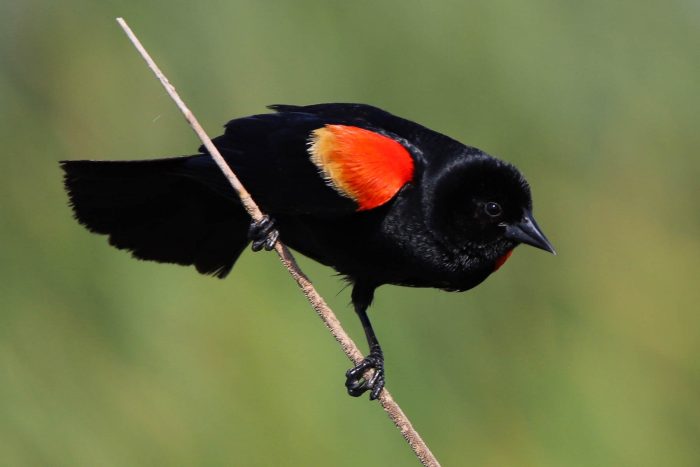
The red-winged blackbird is a black songbird with distinctive red and yellow shoulder patches. It lives in wetlands, marshes and open farm fields throughout the Chesapeake Bay region.
This section shows one large critter image at a time. Use the thumbnails that follow to select a specific image to display here.
This gallery contains a grid of small thumbnails. Selecting a thumbnail will change the main image in the preceding section.
Appearance
Red-winged blackbirds grow to about nine inches in length with a wingspan of 12 to 16 inches. Their tails are medium-length, and they have black, sharply pointed bills. Adult males are glossy black with red shoulder patches bordered in yellow. Immature males have feathers edged in orange, and may have some yellow on their shoulders. Females are dull brown with dark streaks, and they often have a pale breast and pale eyebrow streaks.
Feeding
This bird generally eats whatever it can find, including snails, frogs, worms, spiders and eggs, although it prefers insects such as flies, moths, dragonflies and butterflies in summer. In winter, its diet switches to plants and seeds such as corn and wheat.
Predators
Owls, raptors and raccoons are a few of the red-winged blackbird’s predators.
Flight
Males are easily identified in flight by their bright red and yellow shoulder patches.
Voice
Males make a cheery, loud konk-la-ree or oak-la-ree during breeding season to draw attention to themselves and warn potential intruders.
Reproduction and life cycle
Breeding occurs from early spring through mid-summer. Pairs are not monogamous; males may have up to 15 mates at one time. The red-winged blackbird nests in cattail reeds or bushes near water, where the female weaves a deep, basket-like nest from plant material.
Females have one to three broods per year and will lay three to five eggs with each brood, which they incubate for up to 11 days. Males guard the nest with loud calls and displays, or by chasing other male birds away. They can spend more than one-quarter of daylight hours defending their territory. Young are dependent on females for five weeks after they leave the nest. Red-winged blackbirds usually lives for about two years in the wild.
Did you know?
- Red-winged blackbirds are one of the most abundant bird species in North America.
- Highly social birds, their Latin name, Agelaius, means "belonging to a flock."
- Male red-winged blackbirds can puff up or hide their scarlet and yellow shoulder patches, depending on how confident they feel.
Sources and additional information
- Life in the Chesapeake Bay by Alice Jane Lippson and Robert L. Lippson
- Chesapeake Bay: Nature of the Estuary, A Field Guide by Christopher P. White
- Animal Diversity Web: Agelaius phoeniceus – University of Michigan Museum of Zoology
- All About Birds: Red-winged Blackbird – The Cornell Lab of Ornithology