
Sea squirt
(Molgula manhattensis)
The sea squirt is a marine invertebrae with a rounded, leathery body and two short siphons. It lives on reefs, pilings and other hard surfaces in the shallow waters of the middle and lower Chesapeake Bay.
This section shows one large critter image at a time. Use the thumbnails that follow to select a specific image to display here.
This gallery contains a grid of small thumbnails. Selecting a thumbnail will change the main image in the preceding section.
Appearance
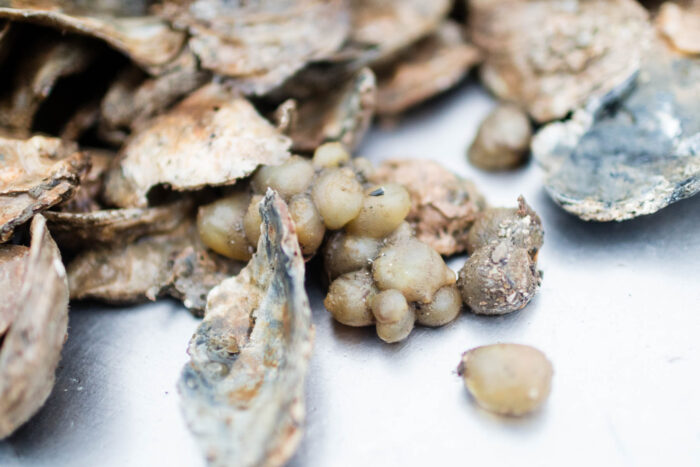
The sea squirt has a round, leathery, yellowish- or greenish-brown body with two short siphons projecting from the top. It grows to a maximum of two inches in length.
Feeding
The sea squirt feeds by drawing water into the body through one of its siphons. Food particles are filtered through the pharynx and digestive tract. Waste products are released from the body through the other siphon.
Reproduction and life cycle
The sea squirt spawns by releasing eggs and sperm into the water. After about three days, eggs develop into free-swimming, tadpole-like larvae. Larvae are fairly sophisticated: they have long tails, a primitive eye and backbone (called a notochord), a slender nerve cord, and a hollow, enlarged brain.
Larvae eventually settle and attach to a hard surface using an adhesive mechanism on the head. In about 3-4 days, the tail, nerve cord and notochord are absorbed, leaving only a small mass of nerve tissue. The body and siphons, as well as digestive, reproductive and circulatory organs, soon develop.
Did you know?
- Sea squirts are also called sea grapes, because a pack of sea squirts looks like a bunch of grapes.
- When prodded, sea squirts will eject a jet of water from one of their siphons.
- Sea squirts are very tolerant of polluted water.
Sources and additional information
- Life in the Chesapeake Bay by Alice Jane Lippson and Robert L. Lippson
- Chesapeake Bay: Nature of the Estuary, A Field Guide by Christopher P. White