
Sika deer
(Cervus nippon)
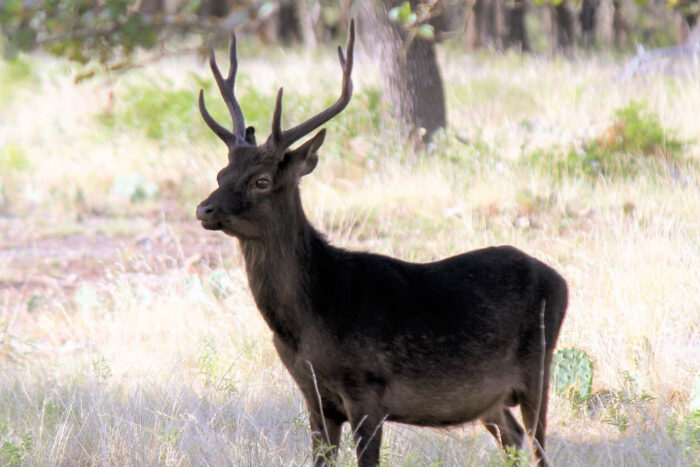
The sika deer is a small, brown elk that lives in quiet marshes and forested wetlands on the lower Eastern Shore of Maryland.
This section shows one large critter image at a time. Use the thumbnails that follow to select a specific image to display here.
This gallery contains a grid of small thumbnails. Selecting a thumbnail will change the main image in the preceding section.
Appearance
The sika deer varies in color from reddish-brown in the summer to dark brown or black in the winter. It has white spots on its back and a white rump. Males have narrow antlers and a dark, shaggy mane on the neck. Sika deer grow to about 2.5 feet tall at the rump. Males usually weigh about 90 pounds, while females usually weigh about 70 pounds.
Feeding
Sike deer have a varied diet, which they adapt to their environment. A sika deer's diet can include marsh grasses, fallen leaves, trees, brushy vegetation, herbs, fungi, myrtle bushes, ground ferns, poison ivy, soybeans and corn. They typically feed at night.
Predators
The sika deer has no natural predators in the Chesapeake Bay watershed, but humans will often hunt them for their meat. Its native predators include tigers and wolves. Sika deer primarily use vigilance to protect themselves from predators, often fleeing when threatened. However, their antlers and sharp hooves can also be used in defense.
Voice
Sika deer are very vocal and communicate with one another using at least 10 different sounds. When alarmed, adult males emit a distinctive, high-pitched “bark" to alert others to danger.
Adult females use soft bleats and whistles to communicate with their young and other females, while young deer emit a soft, horse-like neigh when communicating with their mother. During breeding, males emit a long, multi-pitched wail.
Reproduction and life cycle
Breeding occurs in autumn, beginning in late September. A male sika deer will mate with multiple females over a breeding season, gathering as many as 12 females on his territory each year. During mating season, males rapidly deplete their fat stores and may lose up to 30% of their body weight. Females may associate with several males in order to gain access to a variety of feeding grounds.
After about seven months, the female gives birth to a single calf, typically in forested areas or open field. The mother nurses her newborn calf for up to 10 months on increasingly fatty milk. Most sika deer breed in their second year, but about one-quarter breed in their first year. On average, sika deer live 15 to 18 years in the wild. However, some have been known to live up to 25 years in captivity.
Did you know?
- Although they are called deer, sika deer are actually a member of the elk family. They are also called sika elk or Asian elk.
- Males are called “stags” and females are called “hinds” or “cows."
- They were first introduced in the Chesapeake Bay watershed on James Island in Dorchester County, Maryland, in 1916.
- Previous studies have suggested that although they are an exotic species, sika deer are not considered invasive because they do not directly compete with native wildlife for food and habitat. Some research, however, has suggested that the increasing number and expanding range of sika deer may be of growing concern for the success of native white-tailed deer populations.
Sources and additional information
- Sika Deer – Assateague Island National Seashore
- Animal Diversity Web: Cervus nippon – University of Michigan Museum of Zoology