
Tundra Swan
(Cygnus columbianus)
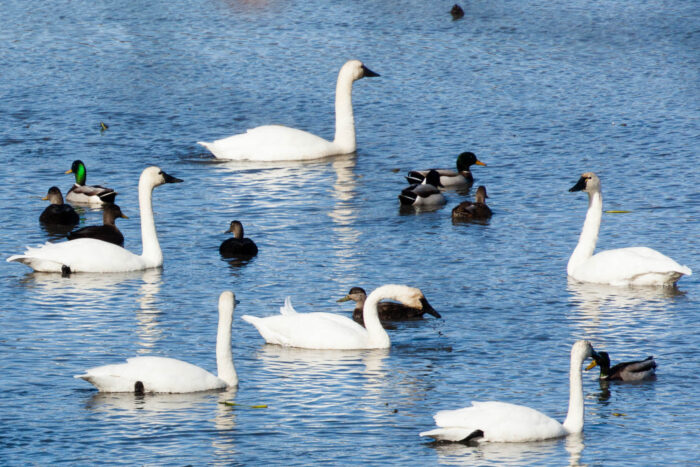
The tundra swan is a large, white bird that visits the shallow waters of the Chesapeake Bay and its tidal rivers and wetlands from autumn through spring.
This section shows one large critter image at a time. Use the thumbnails that follow to select a specific image to display here.
This gallery contains a grid of small thumbnails. Selecting a thumbnail will change the main image in the preceding section.
Appearance
The tundra swan has a white body and long, slender neck held straight in the air. It has a black bill, often with a yellow spot at the base in front of the eye. It grows to about 4.5 feet with a wingspan of more than five feet; males tend to be slightly larger than females.
Feeding
This bird eats seeds and bay grasses such as redhead grass, widgeon grass and sago pondweed. It feeds by submerging its head and neck underwater to reach its food, sometimes “tipping up” its tail in the process. It will also eat winter wheat and other grains in farm fields.
Predators
Foxes, gulls and weasels prey on swan eggs and young.
Flight
Tundra swans migrate in large V-shaped or ribbon-like flocks. They sually live and travel in flocks; some wintering flocks can be quite large. Flocks are often heard before they can be seen. They are strong flyers and take flight by running across the water and slapping their wings on the surface.
Voice
The tundra swan makes a high, whooping woo-hoo, woo-hoo, woo-hoo.
Reproduction and life cycle
Breeding occurs during the summer in the Arctic tundra of Canada and Alaska. In autumn, adults and their young, called cygnets, fly south to the Bay region. Cygnets are as large as adults but are brownish-gray. They molt to white by late winter or early spring, when the swans return to the tundra to breed.
Did you know?
- Tundra swans are also known as the whistling swan. They are the most widespread swan in North America.
- The tundra swan is one of only two native swan species in North America. The other native swan, the trumpeter swan, is a rare visitor to the Bay region.
- They can be confused with the invasive mute swan. You can distinguish a tundra swan by its black bill and straight neck. Also, tundra swans are only found in the Bay region from late autumn through early spring, while mute swans live here year-round.
- During winter, tundra swans sleep mostly on the water.
Sources and additional information
- Life in the Chesapeake Bay by Alice Jane Lippson and Robert L. Lippson
- Chesapeake Bay: Nature of the Estuary, A Field Guide by Christopher P. White
- Waterfowl ID: Tundra Swan – Ducks Unlimited
- All About Birds: Tundra Swan – The Cornell Lab of Ornithology