
Zebra swallowtail
(Eurytides marcellus)
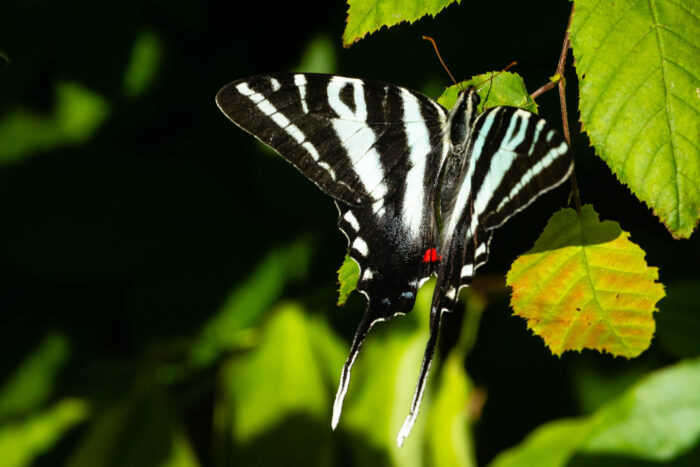
The zebra swallowtail is a butterfly with thick, black stripes on its white wings. It lives in moist, low woodlands where its host plant, the paw paw tree, grows.
This section shows one large critter image at a time. Use the thumbnails that follow to select a specific image to display here.
This gallery contains a grid of small thumbnails. Selecting a thumbnail will change the main image in the preceding section.
Appearance
Zebra swallowtails have long, triangular wings with black, zebra-like stripes on a whitish background. Its wingspan grows to approximately 2 to 4 inches. Two blue spots and long, thin tails appear at the ends of the wings, and red spots appear on the wings near the lower part of the body. The wings are smaller and lighter-colored in early spring. Zebra swallowtails have reddish antennae.
Caterpillars are hairless. They have two color stages: green with yellow and black bands, and dark brown with orange and white bands.
Feeding
Adults feed on nectar from flowers such as redbud, milkweed and verbena. Caterpillars feed on paw paw leaves.
Predators
Eggs are sometimes parasitized by trichogramma wasps and larvae are parasitized by tachinid flies. Ants and spiders are also predators.
Flight
The zebra swallowtail flies erratically and low to the ground with shallow wingbeats.
Reproduction and life cycle
Breeds in moist, wooded areas where paw paws grow. Males patrol the understory to find a mate. After mating, females lay single green eggs on the underside of paw paw leaves or on paw paw trunks. After hatching, caterpillars live on the paw paw leaves as they eat and grow.
Once it is fully grown, the caterpillar uses silk to attach itself to a stem or leaf. It sheds its skin and forms a cocoon called a chrysalis. Inside the chrysalis, the caterpillar morphs into an adult butterfly. It takes about one month for a zebra swallowtail to mature from egg to adult. Adults live up to six months.
Did you know?
- Zebra swallowtails are also known as the pawpaw butterfly, kite swallowtail and ajax.
- Small groups of males often congregate on moist sand and soil. They obtain salt and other nutrients this way.
- The proboscis of the zebra swallowtail is much shorter than other swallowtail butterflies, so they are attracted to shorter, flatter flowers rather than long, tube-shaped blooms.
Sources and additional information
- Animal Diversity Web: Eurytides marcellus – University of Michigan Museum of Zoology
- Attributes of Eurytides marcellus – Butterflies and Moths of North America