
Alewife Floater
(Utterbackiana implicata)
The alewife floater is a mussel that often uses alewife as its host fish.
This section shows one large critter image at a time. Use the thumbnails that follow to select a specific image to display here.
This gallery contains a grid of small thumbnails. Selecting a thumbnail will change the main image in the preceding section.
Appearance
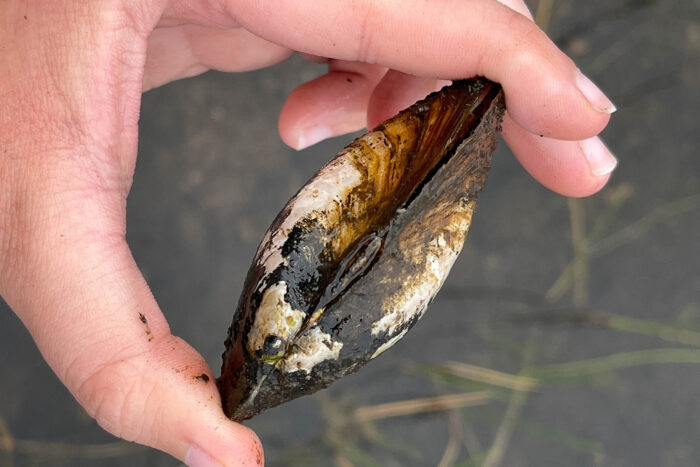
The alewife floater has a smooth, elliptical-shaped shell that can grow up to 6 inches long. Its shell is thin and often appears yellowish-brown to dark green with faint green rays or marks. The inside of the shell is typically silvery or bluish-white.
Feeding
Alewife floaters are filter feeders. They take in water and extract tiny food particles and organic matter on their gills, pushing out cleaner water in the process. This makes mussels like alewife floaters an important contributor to water quality in its habitat.
Predators
Preyed upon by fish, waterfowl, muskrats and other aquatic mammals that feed on their soft tissues or break open their shells.
Reproduction and life cycle
The alewife floater reproduces by releasing its larvae, called glochidia, into the water, where they attach to the gills or fins of a host fish—often the alewife—for development. Once attached, the glochidia undergo a transformation into juvenile mussels. After several weeks, they detach from the host and settle into the sediment to begin their adult life. These mussels can live for several years, filtering water and growing slowly on the river or lake bottom.
Did you know?
- Alewife floaters are named after their preferred host fish, the alewife.
- Alewife floaters are filter feeders that can help make rivers cleaner.
Sources and additional information
- Alewife Floater - Mass.gov
- Alewife Floater - New York Natural Heritage Program
- Alewife Floater - North Carolina Wildlife Resources Commission