
American Avocet
(Recurvirostra americana)
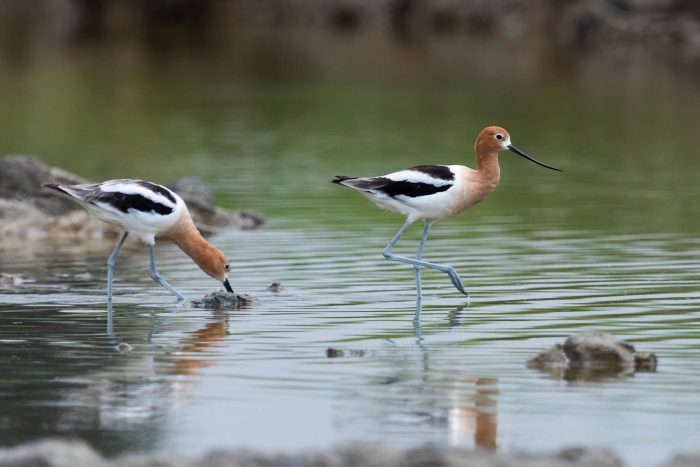
The American avocet is a medium sized bird with a rust-colored head, upturned bill and long legs. It lives in open areas with little vegetation and shallow waters, and can be found throughout the Chesapeake Bay watershed during the winter months.
This section shows one large critter image at a time. Use the thumbnails that follow to select a specific image to display here.
This gallery contains a grid of small thumbnails. Selecting a thumbnail will change the main image in the preceding section.
Appearance
The American avocet is a large, slender shorebird with a long, upturned bill and long legs. These birds have a rust-colored head and a black patch on the back of its mostly white body. Its legs are typically a bluish gray.
Feeding
The American avocet often sweeps its head from side to side with its bill submerged in shallow water looking for small crustaceans and insects to eat. Their diet also sometimes includes seeds, midge larvae and brine shrimp.
Predators
American avocets are often prey to mammals such as raccoons and foxes, as well as other birds such as crows and buzzards.
Flight
American avocets can be identified during flight by their black and white wings on an otherwise largely white body. They tend to hold their wings flat and fly diagonally.
Voice
American avocets often make loud, repetitive wheet, pleet and kleep calls. They can be very noisy when intruders approach their nests.
Reproduction and life cycle
The female American avocet will lay three to five olive-colored eggs. Both parents will take turns incubating the eggs for approximately 23-25 days, with the female typically taking her turn at night. Soon after the young have hatched, they leave the nest to find all of their own food, but typically do not fly until they are about four weeks old.
Did you know?
In response to predators, the American avocet gives a series of call notes that gradually rise in pitch, making its approach seem faster than it actually is.
This species places their nests directly on the ground without the benefit of shrubs to provide shade. To keep the eggs from overheating during incubation, they dip their belly feathers in water.
American avocet chicks leave their nest within 24 hours of hatching. They are able to walk, swim and even dive to escape predators right away.
Sources and additional information
American Avocet Identification - Cornell Lab All About Birds
American Avocet - Cornell Lab All About Birds
American Avocet - Audubon
American Avocet - Smithsonian’s National Zoo & Conservation Biology Institute