
American Shad
(Alosa sapidissima)
Also known as white shad, the American shad is a thin river herring and visits the Chesapeake Bay each spring to spawn in freshwater rivers and streams.
This section shows one large critter image at a time. Use the thumbnails that follow to select a specific image to display here.
This gallery contains a grid of small thumbnails. Selecting a thumbnail will change the main image in the preceding section.
Appearance
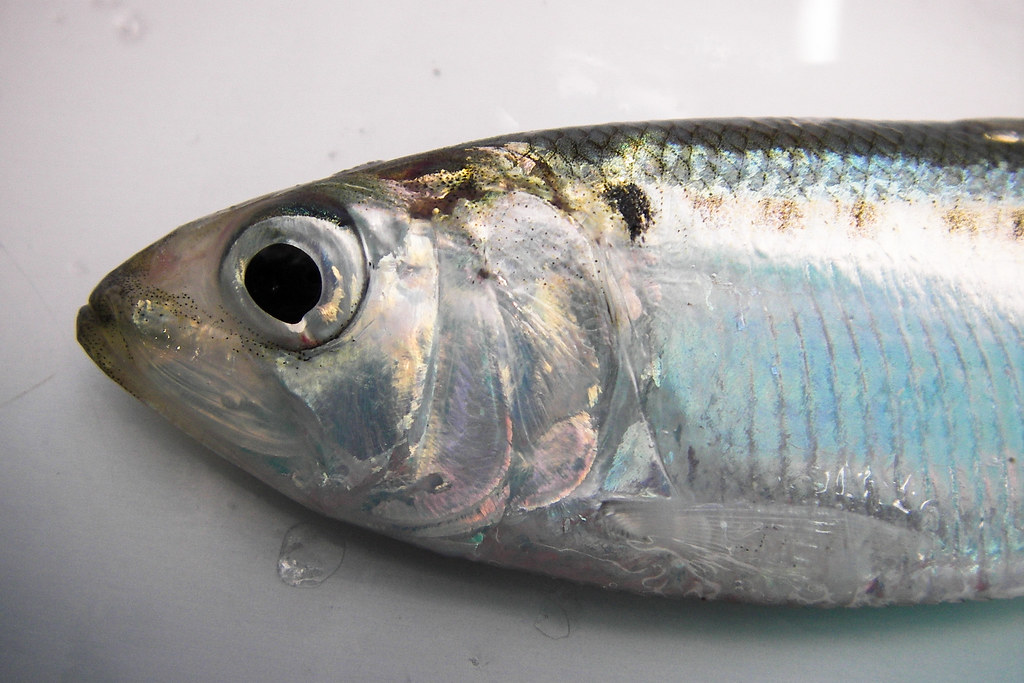
The American shad has a thin, metallic body that varies in color from greenish to dark blue. Its large dark shoulder spot may be followed by several paler spots. Large, easily shed scales come together at its belly to form a saw-toothed edge. It has a deeply forked tail fin. Females are larger than males.
Feeding
In the ocean, American shad feed on plankton, crustaceans and small fish. Adults stop feeding once they begin their upstream spawning migration. Once water temperatures warm and spawning season ends, diets return to normal.
Predators
Shad form an important link between the lower and upper levels of the food web. Adult shad are an important source of food for bears, birds and large fish like striped bass, smallmouth bass, blue fish and channel catfish.
Reproduction and life cycle
Shad are anadromous, which means they live in the ocean but spawn in freshwater rivers and streams. In spring, adults migrate to the waterway in which they were born to spawn. Females lay 100,000 to 600,000 eggs over the course of several days. Eggs drift downstream and hatch in seven to 10 days.
After spawning, adults either die or return to the ocean. Juveniles remain in nursery areas, where they feed on zooplankton and terrestrial insects. In early autumn, most juveniles leave the Bay for the ocean, where they remain for several years before returning to freshwater rivers to spawn. Outside of spawning season, shad can be found in the coastal areas of the Atlantic and Pacific ocean. American shad live six to 10 years.
Did you know?
- The American shad is the largest and most well-known shad species. The largest American shad ever recorded was two feet, six inches long. The oldest American shad recorded in Maryland was 11 years old.
- Shad roe (or eggs) were once considered a delicacy in the Chesapeake Bay region.
- Indigenous people caught shad as a staple food, European colonists kept barrels of salted shad in their homes and during the Revolutionary War, shad were deemed the “savior fish” that fed George Washington’s troops after the harsh winter of 1778.
- Through the nineteenth century, fishermen flocked to the Chesapeake region’s rivers for the spring shad spawning runs. Some communities continue to hold festivals to honor this tradition.
- Shad have a tree named after them: the shadbush blooms in spring, close to the time that shad return to the Bay's rivers to spawn.
- Once the most valuable finfish fishery in the Chesapeake Bay, pollution, historic overfishing and the construction of dams that block the migratory fish from reaching their spawning grounds have lowered shad populations, and the commercial harvest of shad is now closed across much of the region. To restore shad to local waterways, federal agencies, state agencies and tribal governments are working to restock rivers with hatchery-raised fish.
Sources and additional information
- Fishes of Chesapeake Bay by Edward O. Murdy, Ray S. Birdsong and John A. Musick
- Alosa sapidissima: American shad – University of Michigan Museum of Zoology
- Maryland Fish Facts: American Shad – Maryland Department of Natural Resources
- American Shad – Virginia Department of Game and Inland Fisheries