
Atlantic oyster drill
(Urosalpinx cinerea)
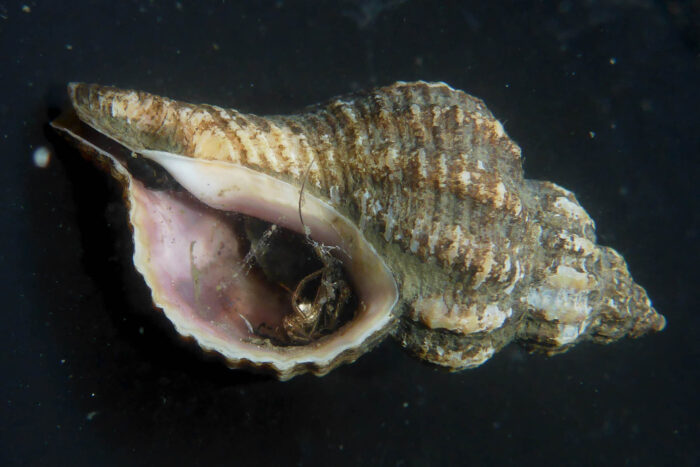
The Atlantic oyster drill is a small, predatory snail with a pointed, ribbed shell. It lives on reefs, rocks and pilings throughout the middle and lower Chesapeake Bay.
This section shows one large critter image at a time. Use the thumbnails that follow to select a specific image to display here.
This gallery contains a grid of small thumbnails. Selecting a thumbnail will change the main image in the preceding section.
Appearance
The Atlantic oyster drill grows to about one inch in length. Its oval-shaped shell varies in color from gray or purplish to tan or yellowish-white and has a pointed spire, or tip. The shell has five to six raised whorls; brown, spiraling vertical ribs; and a thin, flared lip with small teeth.
Feeding
Oyster drills feed mainly on oysters, but will also eat barnacles, mussels and other small mollusks. They secrete an enzyme to soften an oyster’s shell, then drill pin-sized holes through the shell to reach the oyster’s soft parts inside.
Reproduction and life cycle
Spawning occurs throughout the summer. Atlantic oyster drills lay distinctive leathery, vase-shaped eggs that attach to a hard surface. Larvae crawl from the eggs within six to eight weeks.
Did you know?
- Oyster drills are a significant oyster predator, particularly in parts of the lower Bay.
- Oyster drills are gastropods, a type of mollusk that includes whelks, snails and slugs.
- When oyster drills occur in great numbers, they can destroy entire oyster and clam beds, creating serious problems for commercial and recreational shellfishing.
- Oyster drills “smell” their food. Their prey have a distinct body odor, so oyster drills can smell when the shells they are crawling on belong to one of their prey.
Sources and additional information
- Life in the Chesapeake Bay by Alice Jane Lippson and Robert L. Lippson
- Animal Diversity Web: Urosalpinx cinerea – University of Michigan Museum of Zoology
- Oyster Drills – University of Rhode Island
- Oyster drills: the Oyster’s Enemy – Maryland Public Television
- Urosalpinx cinerea (American oyster drill) – Invasive Species Compendium