
Bobolink
(Dolichonyx oryzivorus)
The bobolink is a small, migratory songbird that travels to and from the Chesapeake region from South America each year.
This section shows one large critter image at a time. Use the thumbnails that follow to select a specific image to display here.
This gallery contains a grid of small thumbnails. Selecting a thumbnail will change the main image in the preceding section.
Appearance
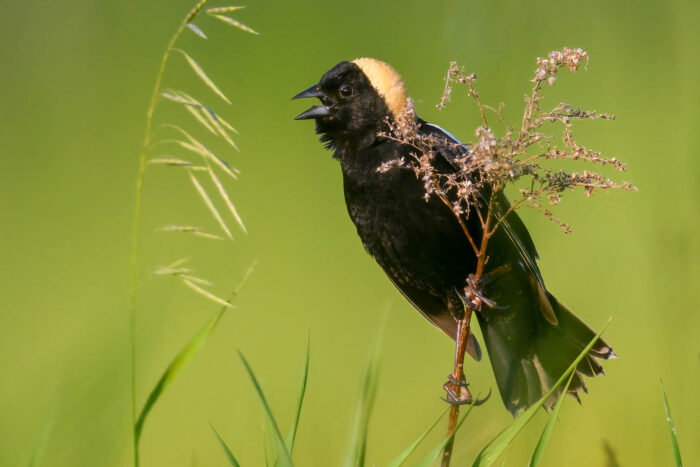
Bobolinks are small songbirds with large heads and short tails. Breeding males have mostly black plumage with a white back and yellow on the nape of their necks, while females and nonbreeding males are a warm brown with dark streaks on their backs and flanks. All bobolinks have prominent brown stripes on the crown of their heads.
Feeding
Bobolinks will forage for seeds and insects by perching on plants while extracting their food slowly and carefully. During the nesting season, they will usually forage in flocks. Their diet primarily consists of insects, seeds, grains and some small berries.
Predators
Bobolinks, juveniles in particular, are often preyed on by larger birds, snakes and mammals.
Voice
Bobolinks will typically sing while in flight with various joyous, bubbling, gurgling phrases and pitches. Songs often consist of trill bzeep-bzeep and chirp-chirp calls.
Reproduction and life cycle
Bobolinks are polygynous, with males often mating with up to 4 females. They are also polyandrous, meaning each clutch of eggs laid by a single female often represents multiple fathers. Males will display courtship by singing, fighting and through elaborate flight patterns. Females will build shallow nests on the ground of grassy areas, and lay a clutch of 3-7 eggs once per year, being incubated solely by the female for 10-13 days. 10-14 days after hatching, nestlings will fledge, although they will still not be able to fly for several days. During that time, they will hide in tall grasses and begin to forage for themselves. About a month later, they will become fully independent. Males will divide their time between the nests of their various mates to help feed the juveniles, but will spend most of the time at their primary nest, which is often that of their first mate.
Did you know?
- Since the bobolink migrates over such long distances each year (typically about 12,500 miles), it travels the equivalent of 4-5 times around the circumference of the earth throughout its lifetime.
- The name bobolink (oryzivorus) means “rice eating,” referring to the species' appetite for rice and other grains, especially during their migration.
- Male bobolinks molt twice a year, meaning they completely change their plumage on both breeding and wintering grounds. When they arrive at breeding grounds, their pale coloring wears off to reveal their attractive black and white colors to appeal to potential mates.
Sources and additional information
- Bobolink - Cornell Lab All About Birds
- Dolichonyx oryzivorus - Animal Diversity Web
- Bobolink - National Audubon Society
- Bobolink, Dolichonyx oryzivorus - New Jersey Department of Environmental Protection