
Devil's Walking Stick
(Aralia spinosa)
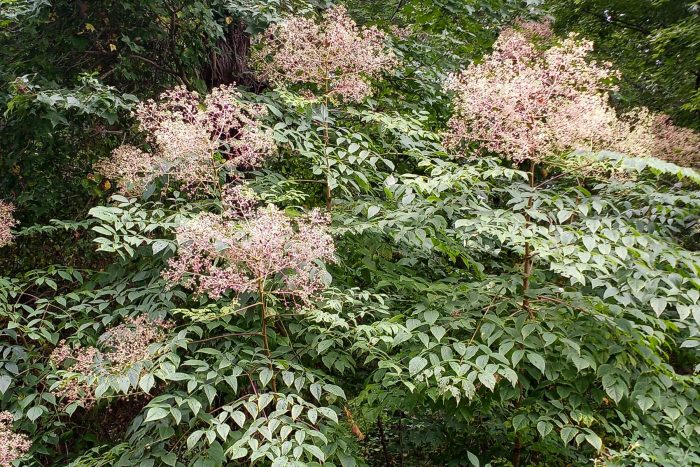
The Devil’s walking stick is a shrub with large leaves and white flowers. The plant derives its name from its thick, thorny stems.
This section shows one large critter image at a time. Use the thumbnails that follow to select a specific image to display here.
This gallery contains a grid of small thumbnails. Selecting a thumbnail will change the main image in the preceding section.
Appearance
The Devil’s walking stick is a large shrub with compound leaves and white flowers blooming in the late summer. The plant can also be distinguished by its coarse, thorny stems and its deep purple berries which bloom in early autumn.
Reproduction and life cycle
Devil’s walking stick produces clusters of small white flowers in late summer that are pollinated by bees and other insects. The plant produces berries in the fall. Birds and other mammals eat these berries and then spread the seeds. Devil’s walking stick also uses underground rhizomes to sprout new plants.
Did you know?
During the American Civil War, Devil’s walking stick was used as a medicine, specifically for toothaches.
Devil’s walking stick gets its name from its long stems which are adorned with thorny spikes.
Although the berries that grow on the Devil’s walking stick are edible for humans, eating too many can be poisonous.
Sources and additional information
Aralia spinosa - North Carolina Extension Gardener
Aralia spinosa (Devil’s walking stick) - Lady Bird Johnson Wildflower center
Devil’s walking stick - The Morton Arboretum
Aralia spinosa Devils-Walkingstick - University of Florida