
Hooked mussel
(Ischadium recurvum)
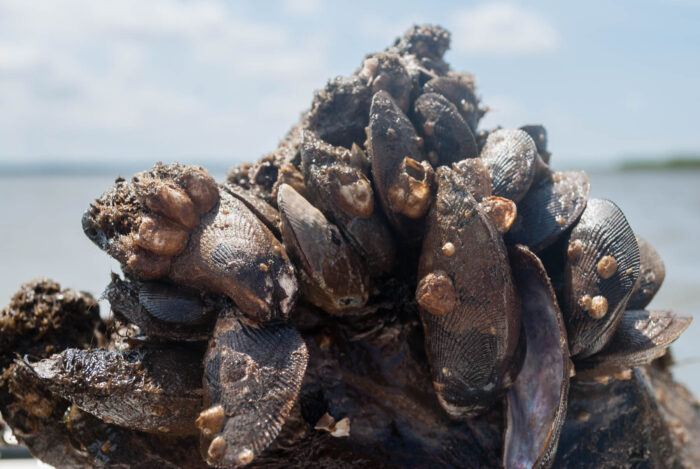
The hooked mussel is a bivalve whose dark, ridged shell is strongly curved, or “hooked” on one end. It is prolific in oyster reefs—often “wrapping up” oysters—and can outnumber the amount of oysters by several fold.
This section shows one large critter image at a time. Use the thumbnails that follow to select a specific image to display here.
This gallery contains a grid of small thumbnails. Selecting a thumbnail will change the main image in the preceding section.
Appearance
The hooked mussel is small, generally reaching one to two inches long. Its shell surface has distinct ridges and curves, and has a dull-colored black or gray exterior with a shiny purple or rosy brown interior. The front end of its shell is strongly curved, or “hooked.”
Feeding
Hooked mussels are filter feeders that open their shells during high tide, drawing in water and filter food particles over their gills.
Predators
Predators of hooked mussels are primarily seaducks, such as scoters and goldeneye.
Reproduction and life cycle
As hooked mussels reach sexual maturity, their mantle will turn either bright yellow or stippled brown in color. Spawning occurs from June to October. Free-swimming larvae drift in the water for a few months, eventually anchoring themselves on hard surfaces as they mature into adults.
Did you know?
- Research suggests that hooked mussels can more than double the overall filtration capacity of an oyster reef. Hooked mussels also filter picoplankton, the smallest type of marine plankton, twice as effectively as oysters.
- Hooked mussels can actually move by pulling themselves along on their byssus threads—releasing some and reattaching others—although this is a very slow process and they do not move very far.
Sources and additional information
- Study puts some mussels into Chesapeake Bay restoration – Virginia Institute of Marine Science
- Ischadium recurvum - Smithsonian Envirnmental Research Center
- Life in the Chesapeake Bay, Third Edition by Alice Jane Lippson and Robert L. Lippson
- Oysters have sidekick in Chesapeake Bay clean-up – Shorelines: Life and Science at Smithsonian Environmental Research Center