
James Spinymussel
(Parvaspina collina)
The James spinymussel is a rare freshwater mussel found in a handful of streams and rivers in Virginia, West Virginia and North Carolina. One of only a few freshwater mussel species with spines, it serves as an important filter feeder that helps improve water quality in river ecosystems.
This section shows one large critter image at a time. Use the thumbnails that follow to select a specific image to display here.
This gallery contains a grid of small thumbnails. Selecting a thumbnail will change the main image in the preceding section.
Appearance
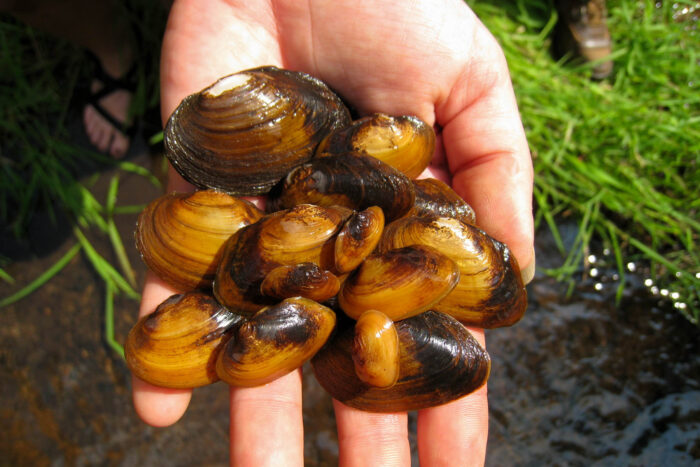
The James spinymussel is a small to medium-sized freshwater mussel with an oval to oblong shell that typically grows to about three inches long. Young mussels have a shiny yellow-brown shell and often display one to three short spines on each shell valve, a feature that gives the species its common name. As the mussels age, their shells darken to brown or black and the spines often wear away. The shell interior is bluish white, while the soft tissues, including the foot and mantle, are usually bright orange.
Feeding
Like other freshwater mussels, the James spinymussel is a filter feeder. It draws water through its siphons and removes microscopic algae, bacteria, plankton and organic particles suspended in the water. This feeding process helps improve water clarity and water quality. Individual freshwater mussels can filter substantial amounts of water each day, making them important contributors to healthy stream ecosystems.
Predators
Predators of the James spinymussel likely include muskrats, raccoons, river otters, some fish and wading birds that feed on freshwater mussels. The mussels gain protection by partially burying themselves in stream bottoms, leaving only a small portion of the shell exposed. Their hard shells also provide some defense against predators.
Reproduction and life cycle
The James spinymussel has a complex life cycle that depends on fish hosts. During spring and early summer, males release sperm into the water, which females draw in while feeding. Fertilized eggs develop into tiny larvae called glochidia within the female's gills. The female then releases the glochidia, which must attach to the gills or fins of certain fish species—especially the bluehead chub and several species of dace and shiners—to complete development. After several weeks, the juvenile mussels detach from the fish and settle onto the stream bottom, where they may live for decades.
Did you know?
- The James spinymussel is one of only a few freshwater mussel species in North America that develops spines on its shell.
- The species was thought to have disappeared from the main stem of the James River, but conservation partners reintroduced propagated mussels there in 2022 for the first time in more than 50 years.
- Freshwater mussels such as the James spinymussel help clean rivers by filtering algae, bacteria and other particles from the water.
- Genetic research led scientists to place the species in a new genus, Parvaspina, in 2017.
Sources and additional information
- U.S. Fish and Wildlife Service: James Spinymussel
- Virginia Department of Wildlife Resources: James Spinymussel
- U.S. Fish and Wildlife Service Species Profile
- Chesapeake Bay Foundation: Freshwater Mussels
- U.S. Geological Survey: Molecular Systematics of North American Spinymussels
- James Spinymussel Recovery Plan