
Millipedes
(Diplopoda)
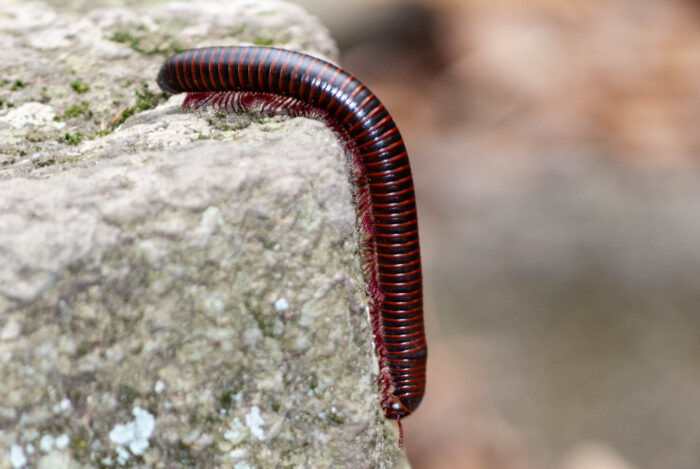
Millipedes are a golden-brown or dark brown colored cylindrical species of invertebrates that often resembles a worm. They can be found all throughout the Chesapeake Bay watershed.
This section shows one large critter image at a time. Use the thumbnails that follow to select a specific image to display here.
This gallery contains a grid of small thumbnails. Selecting a thumbnail will change the main image in the preceding section.
Appearance
The millipede is a cylindrical and often slightly flattened species of invertebrates that typically shows golden-brown to dark brown coloring. Although their name implies they should have a thousand legs, most actually possess fewer than 100, which stick out underneath their bodies.
Feeding
Millipedes are scavengers, meaning they feed on and break down dead plant material, decaying wood particles or rotting fruits, all while rejuvenating the soil.
Predators
Millipedes are prey to shrews, toads, badgers and many types of birds.
Reproduction and life cycle
Every spring, millipedes lay their eggs in the soil. When the offspring hatch after approximately three months, they only have a few pairs of legs. Millipedes undergo “molting,” a process in which they will shed their exoskeleton, at least 7-10 times as they grow into adulthood. Each time they molt, they acquire new segments and legs. They gain new segments and legs until they reach adulthood.
Did you know?
After molting, millipedes will consume their exoskeleton to absorb nutrients.
Some species of millipedes are bioluminescent, and will grow a greenish-blue in the dark.
Some species can produce hydrogen cyanide out of defense, a noxious liquid that can be toxic to small animals.
Sources and additional information
Millipedes - National Wildlife Federation
Centipedes and Millipedes - Oklahoma State University
Millipedes of Ohio- Ohio Division of Wildlife