
Mountain Mint
(Pycnanthemum spp.)
Mountain mint is native perennial that blooms from mid to late summer. It’s considered one of the most ecologically valuable native plants in eastern North America.
This section shows one large critter image at a time. Use the thumbnails that follow to select a specific image to display here.
This gallery contains a grid of small thumbnails. Selecting a thumbnail will change the main image in the preceding section.
Appearance
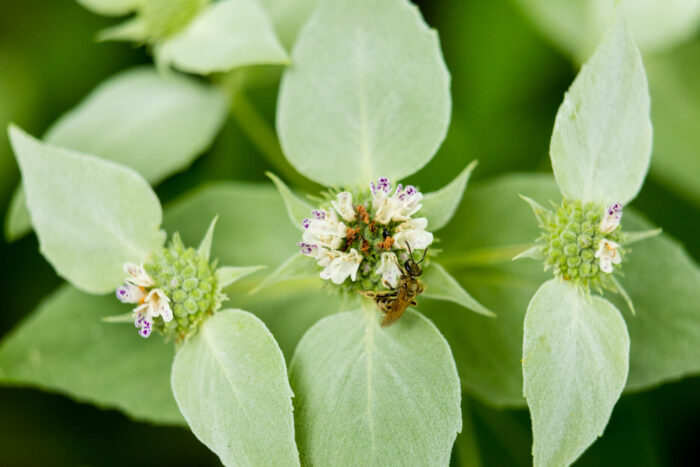
Mountain mint grows in bushy, upright clumps characterized by square stems—a hallmark trait of the mint family (Lamiaceae). Its lance-shaped to dark green leaves are arranged oppositely along the stems and emit a strong, refreshing spearmint or peppermint fragrance when crushed. Near the stem tips, silvery, dust-like leaf bracts surround tight, flat-topped clusters of tiny, two-lipped white flowers dotted with subtle purple spots. While individual blossoms are modest, the silvery bracts underneath give the plant a glowing, frosted appearance that persists for weeks.
Reproduction and life cycle
Mountain mint blooms from July through September. The flowers are rich in nectar and attract a vast variety of pollinators, including long-tongued and short-tongued native bees, predatory wasps, hoverflies and butterflies. After successful insect pollination, the plant produces tiny nutlet seeds held in dark, persistent seed heads. In addition to seed dispersal via wind and gravity, mountain mint expands locally through vigorous underground rhizomes, forming robust, weed-suppressive colonies over time.
Did you know?
- Despite its name, mountain mint does not exclusively grow in high elevations; it thrives across lowlands, coastal plains and river valleys throughout the Chesapeake watershed.
- Pollinator studies routinely rank mountain mint near the top of all native perennials for insect diversity, frequently hosting dozens of distinct species on a single plant at one time.
- The aromatic essential oils contained in its leaves make mountain mint naturally resistant to deer, rabbits and many agricultural pests.
Sources and additional information
- Pycnanthemum (Mountain Mint) - NC State Extension
- Short-toothed Mountain-mint, Pycnanthemum muticum - Virginia Native Plant Society
- Native Plant Profile: Mountain Mint (Pycnanthemum spp.) - Maryland DNR