
Red-Eyed Vireo
(Vireo olivaceus)
Although not easily noticeable at first glance, the red-eyed vireo is one of the most common summer songbirds in the Chesapeake region.
This section shows one large critter image at a time. Use the thumbnails that follow to select a specific image to display here.
This gallery contains a grid of small thumbnails. Selecting a thumbnail will change the main image in the preceding section.
Appearance
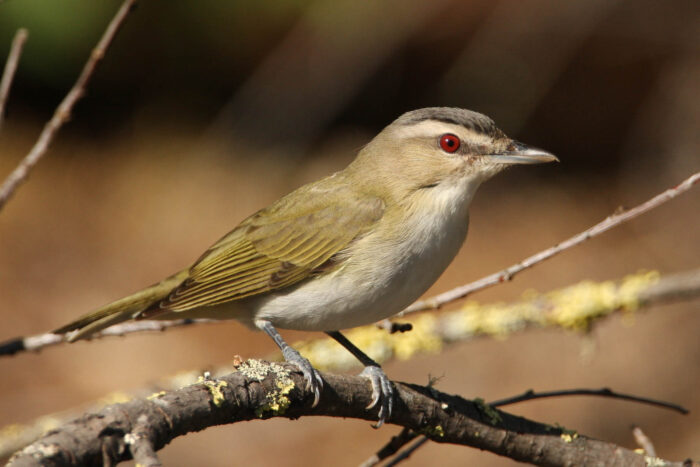
The red-eyed vireo is an average sized songbird with a long, angular head, a thick neck and a long bill that hooks at the tip. They have an olive colored backside and a white belly, with dark gray and white patterned heads. Their most identifiable trait is their red eyes, from which they get their name.
Feeding
Red-eyed vireos do most of their foraging by hopping along tree branches and picking off their food from the underside of leaves. Their diet consists of mostly invertebrates such as caterpillars, beetles and mosquitos in the summer, but shifts to largely seeds and fruits during the colder months. They will also occasionally eat spiders and small snails.
Predators
Predators of red-eyed vireos mostly include jays, crows, squirrels and chipmunks. While the eggs and young are most at risk of being eaten, the adults are also sometimes threatened by these species as well as by some species of snakes and hawks.
Voice
While the red-eyed vireo has many different song patterns, their most common consists of several short notes with varying pitches that sound like cheer-o-wit, chee-chee-ree, sissy-a-wit.
Reproduction and life cycle
During the breeding season of mid-April through August, male red-eyed vireos will sing persistently throughout the day to attract potential mates. They will display their feathers slicked down to the female, swaying their bodies and heads from side to side. Once the female has chosen their mate, both birds will indicate a courtship by vibrating their wings simultaneously. The female will then build a compact nest typically in a shrub, and lay 3-5 eggs which will incubate for about two weeks before hatching. After hatching, the young are fed by both parents until they are ready to leave the nest at 10-12 days old.
Did you know?
- Male red-eyed vireos can sing as many as 20,000 times per day during breeding season to attract females.
- Although the red-eye of the species is its most distinctive feature, the color of the iris does not actually develop until the end of the bird’s first winter. Juveniles are born with dark brown eyes.
- Red-eyed vireos possess a magnetic compass that guides them during migration.
Sources and additional information
- Red-eyed Vireo - CornellLab All About Birds
- Red-eyed Vireo - National Audubon Society
- Red-eyed vireo - Smithsonian’s National Zoo & Conservation Biology Institute
- Bird Profile: Red-eyed Vireo - Schlitz Audubon Nature Center