
Sand Dollar
(Abertalla aberti)
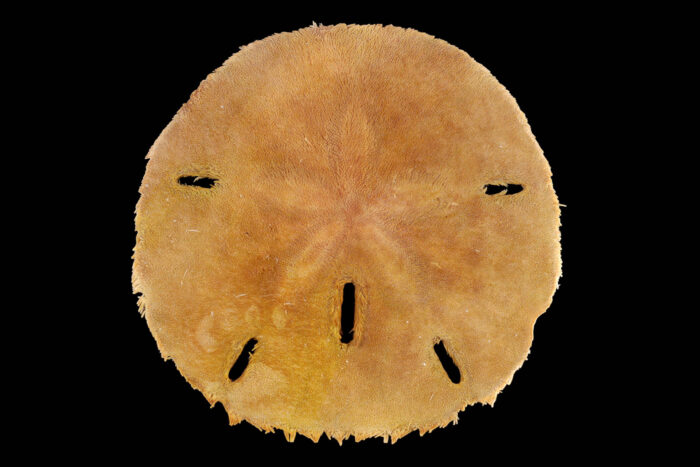
The sand dollar is commonly known for its skeleton’s beautiful appearance that can be found along shorelines, but living sand dollars travel along the ocean floor.
This section shows one large critter image at a time. Use the thumbnails that follow to select a specific image to display here.
This gallery contains a grid of small thumbnails. Selecting a thumbnail will change the main image in the preceding section.
Appearance
Living sand dollars appear reddish-brown to deep purple in color and are covered in cilia, which resembles hair. Their skeletons (which wash up on shorelines and are commonly found by beach-goers) are a small white disk with grooves that appear in a star shape.
Feeding
Sand dollars are opportunistic filter feeders, meaning they will eat almost any plankton or small organisms that come along. This species will use their tube feet to move along the ocean floor and use their cilia to filter organisms from the water column.
Predators
Common predators of the sand dollar are sea stars, crabs and medium sized fish. While sand dollars have defense mechanisms such as small stinging cells on their feet, they are fairly easy to catch as prey since they are slow moving.
Reproduction and life cycle
Sand dollars reproduce through broadcast spawning, where males and females will release clouds of sperm and eggs into the water column at the same time. Gametes will randomly collide and become fertilized, and eggs will hatch after about three weeks. Larvae typically reach the juvenile stage after about three months and will grow to be adults over the next few years.
Did you know?
- Sand dollars are cousins to sea stars and sea urchins as echinoderms, and do not have brains but instead nerve rings that regulate bodily functions.
- The skeleton of the sand dollar is what is commonly seen by beach-goers, and is made out of calcium carbonate, giving it a white appearance once it has dried out.
- The star-shaped markings on the skeleton of the sand dollar mirror its internal structure.
Sources and additional information
- Sea Wonder: Sand Dollar - National Marine Sanctuary Foundation
- Everything You Need to Know About the Sand Dollar - Sand Dollar Shelling
- Sand Dollars Are Truly Priceless - Ocean Conservancy
- Sand Dollar - A-Z Animals