
White Pelican
(Pelecanus erythrorhynchos)
The white pelican is a large waterbird which lives in open and shallow waters and migrates to warmer climates during the winter. As weather has warmed, they have been spotted more frequently in the Chesapeake Bay watershed.
This section shows one large critter image at a time. Use the thumbnails that follow to select a specific image to display here.
This gallery contains a grid of small thumbnails. Selecting a thumbnail will change the main image in the preceding section.
Appearance
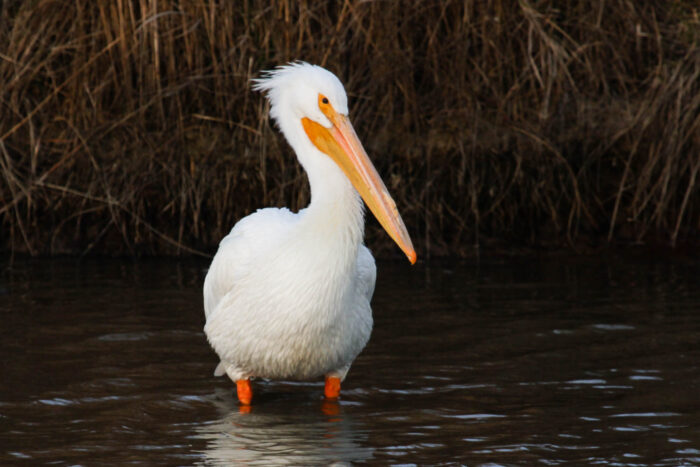
The white pelican is a very large waterbird with broad wings, a long neck and large bill. They have thick bodies, as well as short legs and tails. Although they appear completely white while stationary, their black feathers on the tip of their wings show during flight.
Feeding
White pelicans feed by swimming on the surface and dipping their beaks into the water to catch fish and other aquatic organisms. When foraging at night, they will frequently dip their bills into the water to feel for fish. By day, they locate their prey visually.
Predators
While juveniles and white pelican eggs are subject to be prey of various larger birds and small mammals such as foxes, full-grown pelicans are only known to be prey of red foxes and coyotes on rare occasions.
Flight
White pelicans are soarers, often traveling long distances within flocks. When flapping, the beat of their wings is slow and steady.
Voice
This species is typically silent, sometimes grunting or croaking on nesting grounds.
Reproduction and life cycle
Male pelicans will court females by circling flights, strutting and bowing. Once females have selected their mates, both the male and female white pelicans will use their bills to collect gravel, sand and soil to create a rim about 8 inches high and use the inside as a nest. Females will lay two eggs, although usually only one chick per nest usually survives, as the other will harass or kill the other. After 2-3 weeks, chicks will leave their nest, although their parents will continue to forage for them until they reach maturity after about 3 years.
Did you know?
- White pelicans are among the heaviest flying birds in the world.
- Adult pelicans eat about 2 pounds of food each day, and as opportunistic feeders, their diet ranges widely.
- Male white pelicans tend to be larger than females, but their identical plumage makes it difficult to identify gender at first glance.
Sources and additional information
- American White Pelican - National Audubon Society
- American White Pelican - CornellLab All About Birds
- American white pelican - Illinois Department of Natural Resources
- Too far north for white pelicans? Not anymore - Bay Journal