
A "QuickReef" may lower costs of shoreline restoration
The Eastern Shore Land Conservancy pilots this new material
All across the Chesapeake Bay, waterfront landowners are eager to install “living shorelines” that use natural materials like plants, sand and stone sills to reduce erosion. But the cost of building these shorelines isn’t always feasible.
"We've been really feeling this bottleneck of having super high interest and demand for assistance in living shorelines, but just not enough money to go around,” said Larisa Prezioso, interim director of land conservation at the Eastern Shore Land Conservancy (ESLC).
Now, a new technology called QuickReef could help eliminate some of that bottleneck.
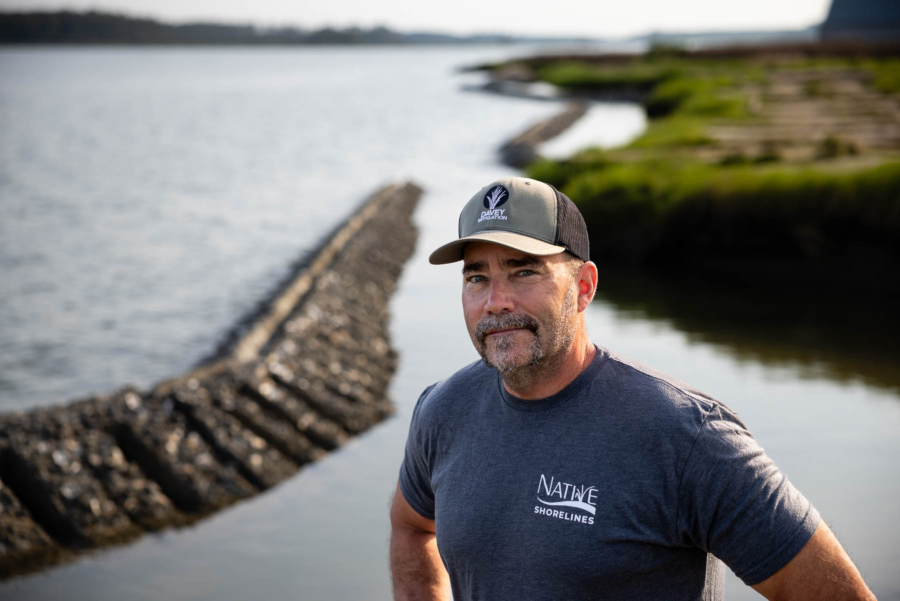
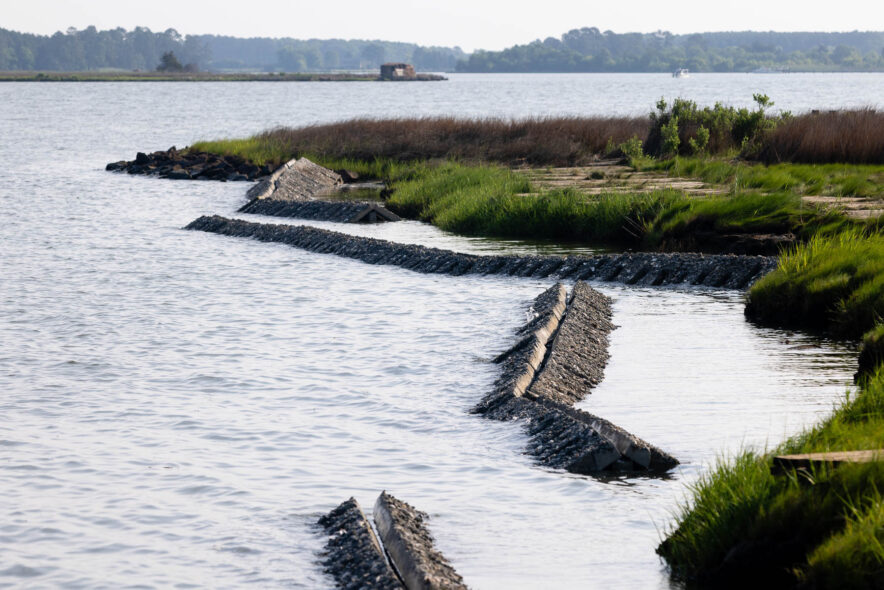
Developed by Native Shorelines, a branch of Davey Tree Expert Company, QuickReef is a calcium carbonate-based material used to make barriers that sit in the water parallel to a shoreline to help slow down wave energy, known as sills.
A traditional sill is made of rock or granite, which typically takes a few weeks or months to install. But QuickReef, which is lighter weight and has a unique interlocking design, can be installed much more quickly, reducing the labor costs on a project.
“One of the whole benefits that we try to bring to QuickReef is the ease at which it gets installed,” said Jeff Corbin, business development and policy manager with Native Shorelines.
For years, living shorelines have helped landowners slow down erosion and land loss while creating high quality marsh habitat for fish, crabs and oysters. The potential to make living shoreline installation faster and more affordable with QuickReef could help environmental groups accelerate restoration across the thousands of miles of shoreline in need of protection.
Putting QuickReef to the test
This summer, ESLC kicked off a study funded by the National Fish and Wildlife Foundation and National Oceanic and Atmospheric Administration to test the suitability of QuickReef along Maryland’s Eastern Shore.
The study began with a pilot project on a landowner’s shoreline on the Little Choptank River. Here, the marsh was already healthy and didn’t require any of the typical plantings or shoreline expansion, only a sill to protect the existing marsh.
Within two half-days and one full-day of work, Native Shorelines was able to install a QuickReef sill along nearly 400 feet of shoreline. While this is small for a living shoreline, Prezioso was impressed by the speed at which the sill was installed.
“The fact that this was built in three days is crazy,” Prezioso said. “I'm bewildered by how fast it took.”
In addition to the pilot project, the organization conducted suitability assessments at 15 different locations along the Eastern Shore to see if QuickReef was a feasible material. The organization assessed each shoreline based on factors including erosion, shoreline access, topography and the presence of underwater grass. The sites also represented a range of wave intensity, with some along rivers where the water is gentler and others that are Bay-facing where the waves are stronger.
So far, the study has shown that QuickReef can be used at all of the 15 locations, including high-energy wave locations.
“We really prioritized viewing many different types of shoreline conditions and many different types of erosion to see if their stuff could work,” Prezioso said. “We’re still working on the last three sites, but for the first 12 that we did, the consensus was that QuickReef can work there.”
A bonus for fish and oyster habitat
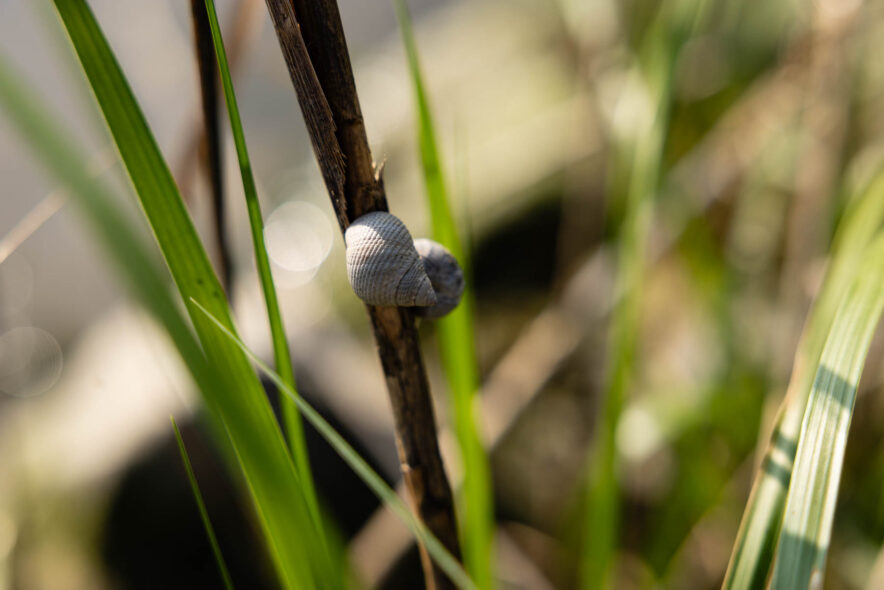
Beyond its fast installation, QuickReef is also designed to attract oysters—making it a suitable home for the Bay’s iconic bivalve.
QuickReef’s unique ratio of 90% limestone marl (sourced from a 30-million-year-old deposit in North Carolina) and 10% concrete binder allows it to mimic a natural oyster shell that juvenile oysters (or spat) will latch on to. In ideal conditions, QuickReef will resemble a natural oyster reef in just a few seasons.
Additionally, the material has enough open space for other marine life to move in and out of, creating good habitat to find food or evade predators.
“If this were a pile of rock, there’d be little to no interstitial space,” Corbin said. “But what we try to do is make sure there is as much open space there in the middle as possible for fish habitat.”
Prezioso pointed out that not every project will be as simple as the one on the Little Choptank River or the 15 others that were studied. Still, the organization’s research appears to demonstrate the value of using QuickReef for living shoreline projects on the Bay.
“I think there's still a lot of confidence and encouragement in the fact that you could look at replacing one-to-one, the rip rap component in any of these shoreline projects with QuickReef product and still see that immediate, ecological benefit of having that oyster habitat or that fish nursery,” Prezioso said.
Comments
This is an awesome remedy that seems a lot more cost effective to save beach fronts too without a huge cost to local town ( public) property too, that want to save their beaches without being forced to change the landscape of their beach frontage (as in turning it into a marsh that is a living shoreline but not a safe area to swim as a beach).
QuickReef seems to be an excellent way to restore portions of the Bay!
Thank you!
Your comment has been received. Before it can be published, the comment will be reviewed by our team to ensure it adheres with our rules of engagement.
Back to recent stories