
A sunny disposition
Chesapeake farmers show that solar energy and agriculture don’t have to be at odds
Across the Chesapeake Bay watershed, farmers are incorporating solar energy into their businesses. With plenty of open land, farmers have the opportunity to set up solar arrays that generate electricity and provide additional revenue streams.
But traditional installations can cause the land underneath panels to go unused—limiting crop production and grazing.
Agrivoltaics offers a solution by combining farming and solar energy generation on the same tract of land.
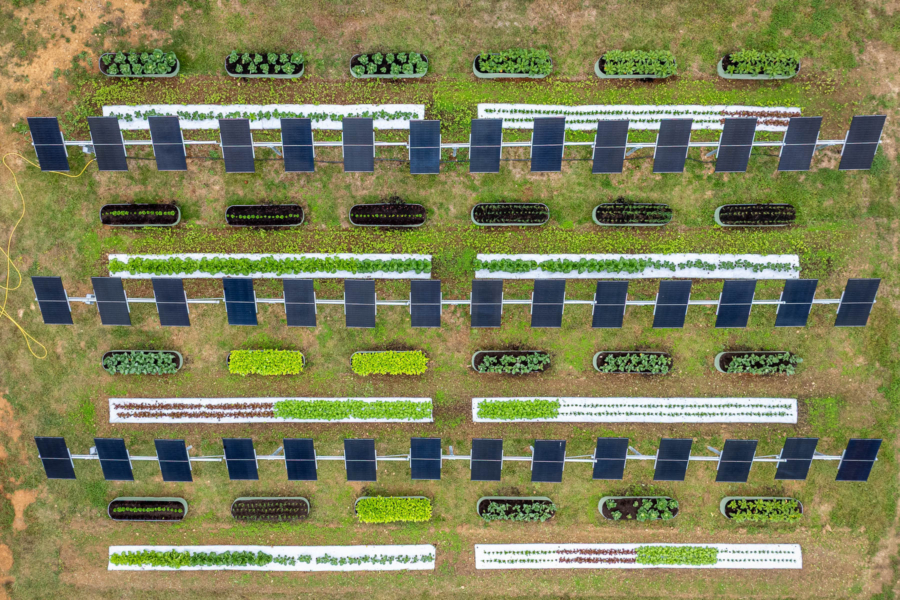
In October 2025, the Piedmont Environmental Council (PEC) installed Virginia’s first ever crop-based agrivoltaics system at its Roundabout Meadows community farm in Loudoun County. Forty-two solar panels—raised 6 to 8 feet high—send just under 20 kilowatts of electricity to a battery that powers the property, whether it’s sunny or cloudy. According to PEC, this system powers 100% of the farm’s energy needs, with excess electricity earning financial credits through a virtual power plant program.
Just as importantly, rows of vegetable crops continue to grow underneath those panels. The panels are positioned in a way that generates electricity but also allows sufficient sunlight and rainwater to reach the plants. Some research shows that this system is even beneficial to crops, as the shade provided by the panels can result in less water use, healthier soil and less stress on plants during the summer.
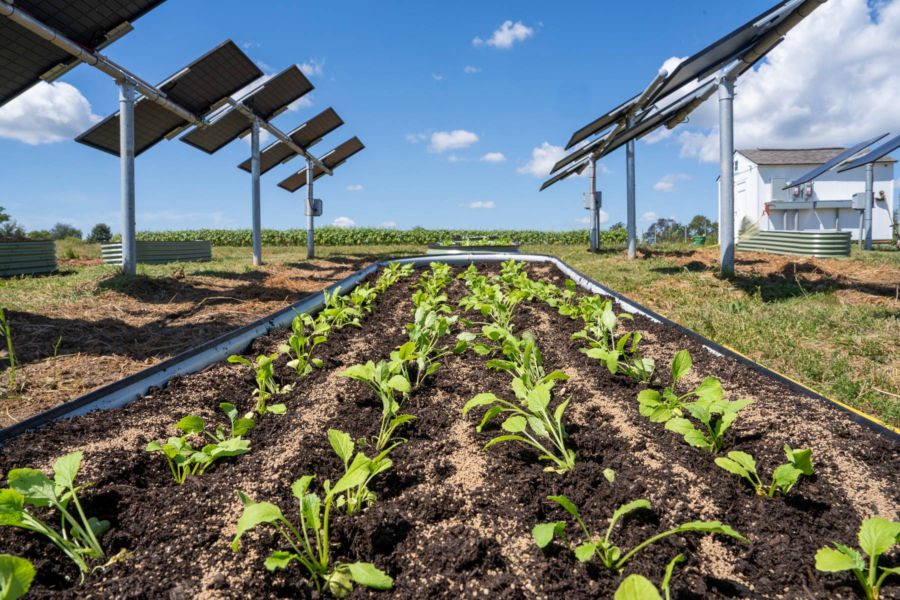
The Chesapeake region has a wide variety of climates, soil types and topography, so one farm’s agrivoltaics system won’t necessarily work on another. One of the primary goals of PEC’s agrivoltaics project is to collect data that can be used by other farmers and lawmakers. PEC tracks information like energy production, water use, soil health and crop growth to determine how well similar systems could work in other places—or what improvements can be made.
Agrivoltaics systems don’t have to include crops. Sheep farmers across Maryland, Virginia, Pennsylvania and New York are grazing their flocks around solar panels in mutually beneficial dual-use scenarios. Livestock grazing saves on mowing costs and improves the health of the soil, which leaves the land more equipped to soak up runoff from surrounding areas.
In Frederick County, Maryland, the owners of Maryland Solar Grazing Solutions are hired by landowners with solar arrays to have their sheep graze the fields. According to the Kidds, this can be a more sustainable and affordable way of managing the vegetation than hiring a landscaping crew. In 2025, the Kidd’s sheep grazed over 100 acres on Maryland farms.
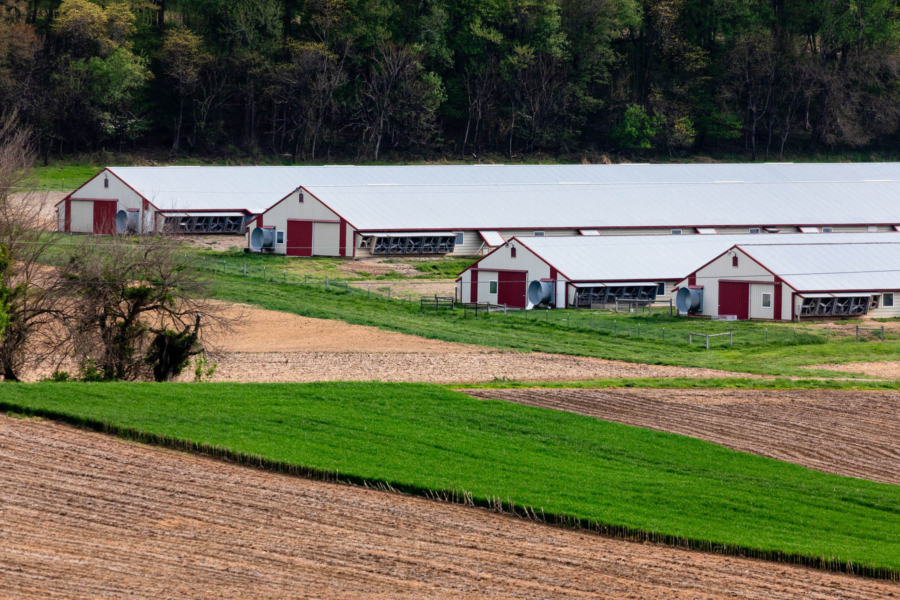
Farther up in the Bay watershed, in Lancaster County, Pennsylvania, farmer Mark Rohrer has solar panels installed on the roof of his chicken houses. Rohrer and his brother first installed two sets of solar arrays in 2011, with assistance from state and federal programs. In 2024, the Rohrers added a third set of solar arrays. According to Rohrer, these arrays power all the energy needs of the chicken houses.
Solar projects such as these are helping farmers in the Chesapeake region meet energy needs without losing critical farmland. Conserving farmland is important not only for food production, but because the unpaved land that exists on farms soaks up runoff and protects nearby waterways better than highly developed land.
Agrivoltaics is one way that communities can balance these critical priorities.
Comments
There are no comments.
Thank you!
Your comment has been received. Before it can be published, the comment will be reviewed by our team to ensure it adheres with our rules of engagement.
Back to recent stories