
Landowners find their perfect match
Conservation speed-dating workshops help farmers find conservation programs for their properties
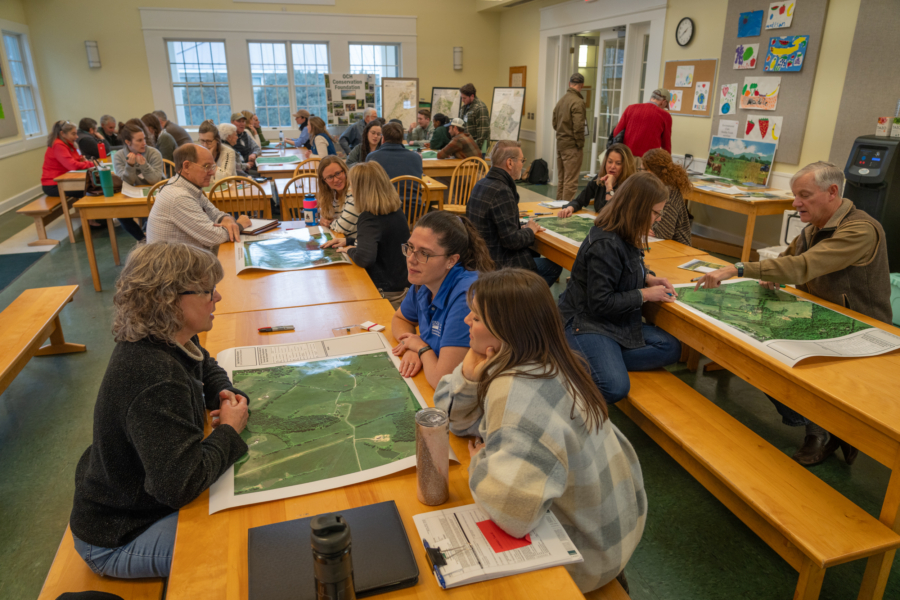
Speed-dating was created to make it easier for people to find the perfect match by meeting dozens of potential suitors in one night. What happens if we apply that date to conservation? It might be true love!
Conservation Speed-Dating takes the guess work out of conservation for landowners. The only requirement is to show up and spend a few hours getting to know your neighbors and technical service providers. The program was created by the Virginia Grassland Bird Initiative (VGBI) alongside the Shenandoah Valley Conservation Collaborative and Rappahannock River Roundtable. The program brings together networks of landowners and conservation organizations to help everyone find their match.
In one workshop, landowners can meet with technical service providers and conservation practitioners that work in their area. Landowners receive a 24” by 36” map of their property and spend about 10 minutes each with different technical service providers to learn about programs and see what they can implement on their property. Landowners leave the workshop with a comprehensive knowledge of regional programs, direct contacts for follow-up questions and time spent building community with their neighbors.
October Greenfield serves as the VGBI co-coordinator and has worked on these workshops since they started. Greenfield says the workshops provide an opportunity to “dream big and when you're ready to take the first step, you know who can help you with that and you can do it piece by piece. It's not an all or nothing kind of thing.”
Totier Creek Farm
Sophie Massie owns Totier Creek Farm in Albemarle County, Virginia. Massie grew up on a cattle farm in Rappahannock County and was always taught to care for the land, so she knew she wanted to use good practices on her own property. Shortly after purchasing her land, she worked with the James River Association to install a riparian buffer along the creek.
Massie eventually attended a speed-dating workshop after being invited by a fellow farmer who was hosting the event. She had noticed an increase in water contamination in Totier Creek caused by new agricultural operations in the area that were not using conservation-minded techniques. After meeting with providers at the workshop, Massie decided to extend her existing buffer with the James River Association to better protect the waterway.
“We are so spoiled in this region with excellent conservation opportunities. The Conservation Speed Dating Speed Dating Service is a fun, charismatic crash course in all the region's wonderful offerings” said Massie.
Beyond projects on her own property, Massie is protecting the watershed by working with fellow conservationists and landowners to start the Totier Creek Watershed Association.
Rooted Land Company
Zachary Whitman is the owner of Rooted Land Company on the Rapidan River in Madison, Virginia. When Whitman purchased the property in 2020, he found unhealthy forest and farmland and an eroding stream.
Whitman joined the Natural Resources Conservation Service (NRCS) Environmental Quality Incentives Program (EQIP). Through the EQIP program he was able to remove invasive species and plant 1,685 trees in a buffer, that will help reduce erosion and runoff in the stream. Whitman hopes that the buffer will help bring native brook trout back to the stream.
Historically, the property had an abundance of ash trees but due to the emerald ash borer, the trees have died and the invasive tree-of-heaven took their place. By the time Whitman moved in, thousands of invasives were on the property. After three years of treatment, he has removed 80% of the invasive trees.
While Whitman already had a good understanding of local programs, he learned about American kestrel nest boxes during a Conservation Speed-Dating workshop. He had seen nest boxes on properties in the area but he didn’t know where people got them or what species they were for. He installed a box in 2024 and is currently waiting for his first kestrel family to move in. Whitman has multiple vacation properties on his land and the kestrel box is in the flower garden where guests get to see it and learn about the restoration effort. Following the workshop, he also converted two acres of Japanese stiltgrass into a pollinator meadow for the benefit of local wildlife and his visitors.
Whitman enjoyed the community-building aspect of the workshop and noted that some of his neighbors are now using delayed mowing to protect grassland birds. He has reconnected with other attendees who are now using best management practices for cattle on their farms. Based on what he learned at the workshop, Whitman can now recognize these conservation practices on other farms while driving through the neighborhood.
“Most everybody out here is cognizant about conservation and are stewards of nature,” said Whitman.”It's nice to know who else is taking their time, or investing their finances or energy into the land.”
Whitman is far from considering his conservation efforts complete. He is still working with the Friends of the Rappahannock to continue to care for and expand his riparian buffer. In 2026, he will work with the Virginia Department of Forestry to restore the mid-level canopy on five acres of forest. He also plans to expand the pollinator meadow by an additional four acres. Whitman has seen a ripple effect of people wanting to learn more about conservation efforts from visitors to the farm or following along on Instagram.
Ready to go on a date?
While not every landowner will implement every available practice, the regional conservation effort becomes far more comprehensive when each participant adopts at least one strategy. One neighbor installs a kestrel box, another installs a riparian buffer, another delays mowing, another enters a conservation easement and over time wildlife has more habitat and the watershed is protected.
Conservation Speed-Dating might not be the first or last step in a landowners conservation journey but it is a helpful way for them to get in-person experience with technical service providers. If you’re in one of the 16 counties served by the VGBI, reach out to see if they plan on hosting a workshop in your area. If you’re outside of that zone, see if your local conservation organization would be interested in hosting a workshop. The VGBI created a Guide for Hosting Conservation Speed-Dating Workshops so anyone can copy the model.
Comments
Thank you for the informative article. Your blog post provided valuable insights and practical advice on the topic.
Thank you!
Your comment has been received. Before it can be published, the comment will be reviewed by our team to ensure it adheres with our rules of engagement.
Back to recent stories