
Restoring the star of Broadway (Virginia)
Ecosystem Services chooses the Linville Creek mainstem to focus restoration
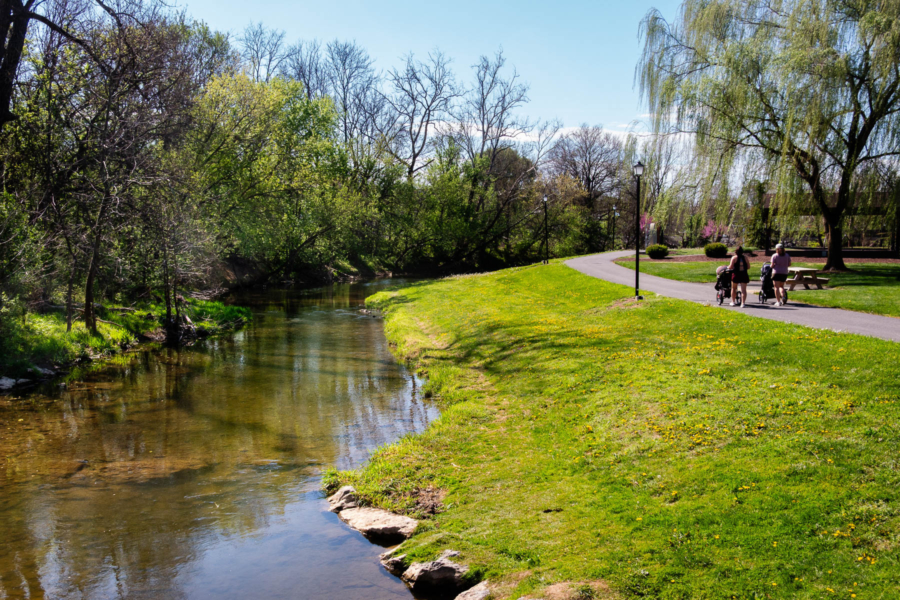
In the small town of Broadway, Virginia, Linville Creek flows prominently through Heritage Park, a five-and-a-half-acre green space in the center of town. Here, residents can walk down a small slope to greet the gentle stream. And for the past thirteen years, town leaders have held a Kids Fishing Day where the waterway is stocked with fish for young anglers.
“[The stream] is very visible and very well-loved,” said Annemarie Ford, Director Environmental Science with Ecosystem Services.
Despite its popularity, Linville Creek suffers from poor water quality, with limited aquatic life.
The stream’s watershed flows through Shenandoah Valley farmland where nutrient and sediment runoff worsen fish and insect habitat. At Heritage Park, where the mainstem Lineville Creek flows, the stream was widening from large deposits of sediment, with the banks eroding and trees starting to lose their root system. This excess sediment flowed into the North Fork of the Shenandoah River, about a mile from the park, and east toward the Chesapeake Bay.
Responding to the needs of the entire stream, the National Fish and Wildlife Foundation (NFWF) provided funding to Ecosystem Services to assess the Linville Creek watershed.
“We had our first NFWF grant, which was a watershed assessment to prioritize where we should even do restoration,” Ford said. “Linville Creek at Heritage Park ranked pretty highly.”
In 2020, Ecosystem Services carried out a stream restoration project on roughly 1,150 feet of Linville Creek and 210 feet of a small tributary within Heritage Park. The work reconnected the stream to its floodplain, improved the channel’s ability to move sediment and strengthened the previously eroded banks. Throughout the process, Ecosystem Services removed a few of the dying trees before they fell into the stream on park property.
According to Ford, the project became a learning opportunity for environmental science students from Eastern Mennonite University.
“They came out and saw the construction…and they came out during monitoring,” Ford said.
With restoration completed, the mainstem of Linville Creek now behaves as a healthy stream should: flowing with natural ripples and depositing sediment along the banks or at the base of the channel. While the stream may not be teeming with native fish and aquatic insects just yet, the condition of the water flowing to the Shenandoah River and Chesapeake Bay has been improved. And Broadway residents can enjoy cleaner water.
Comments
There are no comments.
Thank you!
Your comment has been received. Before it can be published, the comment will be reviewed by our team to ensure it adheres with our rules of engagement.
Back to recent stories