
Chesapeake Executive Council
The Chesapeake Executive Council establishes policy direction for the restoration, conservation, and protection of the Bay, and is accountable to the public for progress toward the Chesapeake Bay Watershed Agreement.
Meetings
No upcoming meetings.
2025 Chesapeake Executive Council Meeting
2024 Chesapeake Executive Council Meeting
2023 Chesapeake Executive Council Meeting
About
The Chesapeake Executive Council consists of the governors of the six watershed states, the mayor of Washington, D.C., the chair of the Chesapeake Bay Commission and the administrator of the U.S. Environmental Protection Agency.
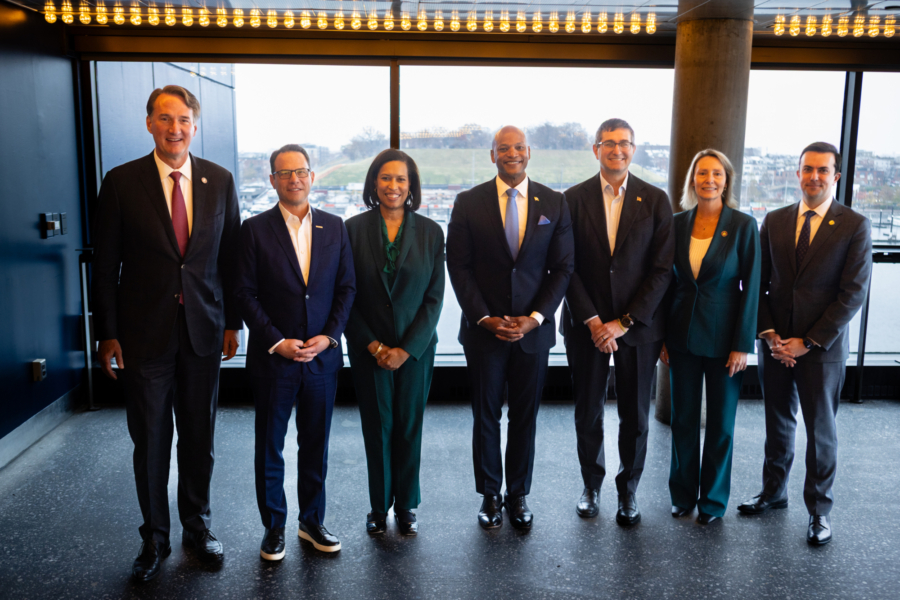
The Executive Council meets at least annually, and establishes the vision and policy direction for the restoration, conservation and protection of the Chesapeake Bay. It encourages public support and ensures transparency for the Bay restoration, conservation and protection effort, and is accountable to the public for progress made toward the Chesapeake Bay Watershed Agreement.
History
The Chesapeake Executive Council was established by the 1983 Chesapeake Bay Agreement. Under the 1987 Chesapeake Bay Agreement, membership changed from cabinet secretaries to the governors of Maryland, Pennsylvania and Virginia, the mayor of Washington, D.C., the chair of the Chesapeake Bay Commission and the administrator of the U.S. Environmental Protection Agency. Chesapeake 2000 marked the official inclusion of the Bay’s headwater states (Delaware, New York and West Virginia) in the Bay Program’s restoration efforts. The governors of New York and Delaware committed to the agreement's water quality goals through a memorandum of understanding signed in 2000. The governor of West Virginia added his signature in 2002.
Publications
2025 Chesapeake Bay Watershed Agreement
Publication date:The Chesapeake Bay Watershed Agreement is a collaborative commitment to restore, conserve and protect the nation’s largest estuary and its surrounding watershed.
View document [PDF, 10.9 MB] 2025 Chesapeake Bay Watershed Agreement
Charge to the Principals' Staff Committee: Tribes as a Formal and Enduring Partner in the Chesapeake Bay Program
Publication date:This charge directs the Principals' Staff Committee to work with federally recognized tribal nations to develop recommendations on how best to include tribes across the watershed in the Chesapeake Bay Program partnership.
Directive 24-1: Establishment of a Chesapeake Bay Program Agricultural Advisory Committee
Publication date:This directive establishes a new advisory committee to facilitate greater engagement of the agricultural sector in the Chesapeake Bay Program.
Charge to the Principals' Staff Committee: Charting a Course Beyond 2025
Publication date:This charge directs the Principals' Staff Committee to revise the 2014 Chesapeake Bay Watershed Agreement and recommend a simplified and streamlined structure and process for the Chesapeake Bay Program partnership.
Charge to the Principals' Staff Committee: Charting a Course to 2025 and Beyond
Publication date:This charge directs the Principals' Staff Committee to recommend a path for meeting the goals and outcomes of the 2014 Chesapeake Bay Watershed Agreement leading up to and beyond 2025.
Our Members
- Josh Shapiro (Chair)
Commonwealth of Pennsylvania governor@pa.gov - Marisa Baldine (Coordinator)
Alliance for the Chesapeake Bay mbaldine@chesapeakebay.net - Kelly Hitz (Coordinator)
Pennsylvania Department of Environmental Protection khitz@pa.gov - Muriel Bowser
District of Columbia eom@dc.gov - Kathy Hochul
State of New York gov.hochul@chamber.state.ny.us - Matt Meyer
State of Delaware matt.meyer@delaware.gov - Wes Moore
State of Maryland moore.wes@maryland.gov - Patrick James Morrisey
State of West Virginia patrick.morrisey@wv.gov - Abigail Spanberger
Commonwealth of Virginia abigail.spanberger@governor.virginia.gov - Gene Yaw
Chesapeake Bay Commission gyaw@pasen.gov - Lee Zeldin
U.S. Environmental Protection Agency (EPA) zeldin.lee@epa.gov