
Bay scallop
(Argopecten irradians)
The bay scallop is a bivalve that lives in the lower Chesapeake Bay’s salty, shallow waters. Its ribbed, multicolored shells are often found on beaches throughout the lower Bay.
This section shows one large critter image at a time. Use the thumbnails that follow to select a specific image to display here.
This gallery contains a grid of small thumbnails. Selecting a thumbnail will change the main image in the preceding section.
Appearance
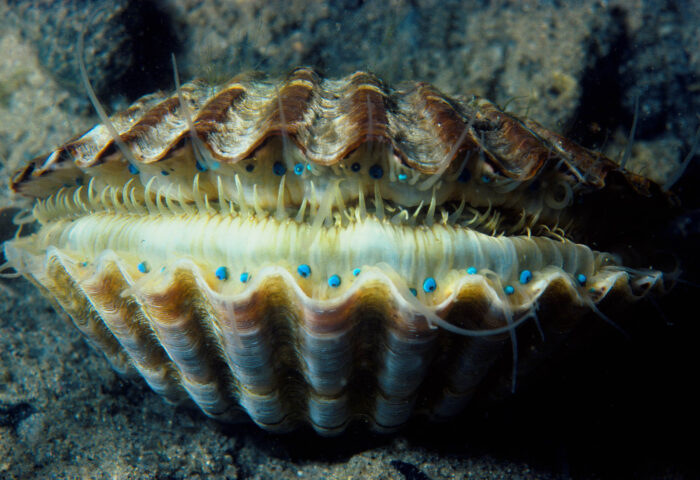
Bay scallops have rounded, corrugated shells that vary in color from gray or purple to reddish-brown. The interior of the shell is white, often with purple near the hinge. A pair of pointed “ears” appear at the shell's hinge. Scallops have short tentacles and 30 to 40 blue eyes around the edge of their shells. Unlike most other bivalves, bay scallops lack a foot or siphon. These scallops grow to 3 inches in diameter.
Feeding
Scallops are filter feeders, drawing water through their gills and filtering out plankton.
Predators
Sea stars and other bottom-feeders prey upon bay scallops. They use their eyes to detect nearby predators.
Reproduction and life cycle
Scallops reach sexual maturity around age one. Spawning occurs in summer. Young scallops attach themselves to eelgrass and other objects by thin threads. They eventually drop to the bottom as they grow. Bay scallops will live approximately two years.
Did you know?
- Each eye has a lens, retina, cornea and optic nerve, enabling the scallop to see movement and shadows.
- Scallops move by rapidly clapping their shells together, forcibly ejecting water from the cavity. This is different than most other bivalves, which use a foot to move.
Sources and additional information
- Bay Scallops - Florida Fish and Wildlife Conservation Commission
- Bay Scallop - University of Rhode Island
- Maryland Fish Facts: Bay Scallop - Maryland Department of Natural Resources