
Bottlenose dolphin
(Tursiops truncatus)
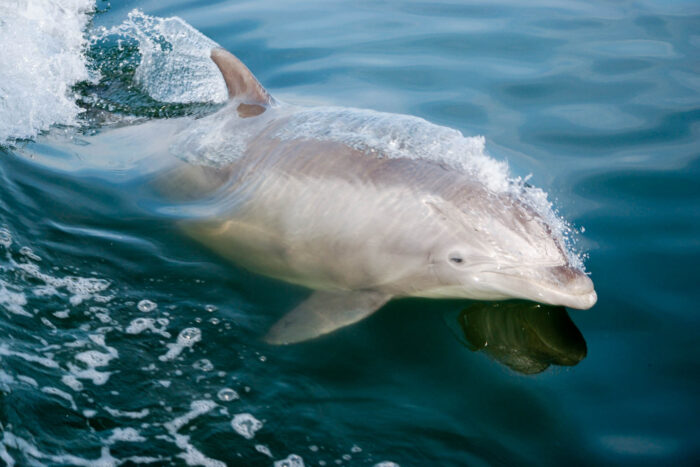
The bottlenose dolphin is a large, grayish aquatic mammal that visits the lower and middle Chesapeake Bay in summer.
This section shows one large critter image at a time. Use the thumbnails that follow to select a specific image to display here.
This gallery contains a grid of small thumbnails. Selecting a thumbnail will change the main image in the preceding section.
Appearance
The bottlenose dolphin has a slender, streamlined body that is grayish in color. Its sides and belly are slightly paler. It has a short, beak-like snout with a slightly longer lower jaw than upper jaw. It has a blowhole on the top of its head. Bottlenose dolphins can grow to 12 feet in length and weigh 300 to 400 pounds.
Feeding
Bottlenose dolphins feed mostly on fish such as spot, croakers, menhaden and silver perch, but will also eat shrimp, squid, crabs and other invertebrates. They use their teeth to grasp prey, then swallow it whole.
Predators
Sharks, such as bull sharks, are dolphins’ greatest predators. Humans threaten dolphins through pollution and recreational fishing gear.
Voice
Dolphins use sound to communicate with other dolphins, navigate through the water, watch for predators and find prey. Sounds include clicking, creaking, squeaking and whistling. Each dolphin is believed to have its own unique whistle. Puffing and hissing sounds can be heard when they exhale through their blowholes.
Reproduction and life cycle
Mating occurs throughout the year. Females give birth to one calf every three to six years, with a gestation period of about 12 months. Calves are born in the water. During the birth, an assisting dolphin (which may be either male or female) remains close to the mother.
This assisting dolphin is often the only other dolphin allowed near the newborn calf. Calves begin nursing within several hours of birth and will feed on their mother’s milk for 18 months. Females reach sexual maturity between five and 12 years old, while males mature at 10 to 12 years old. Bottlenose dolphins usually live about 20 to 25 years, but some may live longer than 40 years.
Did you know?
- The bottlenose dolphin is the most common dolphin found along the Atlantic coast.
- They travel in small schools, or “pods,” of two to 15 dolphins and can feed in fresh waters for short periods of time.
- Dolphins are extremely social, intelligent mammals. But even though they look friendly, bottlenose dolphins can be aggressive. They have been known to attack sharks and porpoises.
- They spend about one-third of each day sleeping, usually just below the surface of calm waters.
- Dolphins come up for air one to two times per minute, although some bottlenose dolphins have been known to stay underwater for more than four minutes.
- They usually swim two to four miles per hour, but can swim nearly 18 miles per hour.
Sources and additional information
- Life in the Chesapeake Bay by Alice Jane Lippson and Robert L. Lippson
- Animal Diversity Web: Tursiops truncatus – University of Michigan Museum of Zoology
- Common Bottlenose Dolphin - NOAA Fisheries